Your Entity. Your Virtual Employees. Our Machinery Underneath.
You want to own the entity and the Virtual Employees that run inside it. The hard part is the 200 operational tasks underneath, payroll, PF/ESI filings, compliance, facilities, while your team focuses on actual work and while the VE stack compounds on your data. That is what we do. Your name on the entity. Your Virtual Employees trained on your data. Our machinery underneath. Your team never knows we exist.
An owned operating asset that travels with the company at exit. Not an outsourcing contract.
The COPO Process
You own the entity and the employees from the start. We manage the operational infrastructure underneath.
Entity Registration
We help you incorporate your Indian subsidiary through the Ministry of Corporate Affairs. You own the entity from the start, with your name on the registration.
Infrastructure Setup
While the entity is being registered, we set up the office, IT infrastructure, and all operational systems in the city you choose. Move-in ready by the time registration completes.
Talent Recruitment
Reliable recruits your team, but every offer letter goes out under your entity. Employees join your organization directly. No secondment, no transfer needed later.
Virtual Employee Design
Alongside the first human hires, we design the Virtual Employees they will run. Scope per VE. Persistent memory architecture on your data, inside your entity. Governance routing to your named human owners. Cost-per-action budget. Every VE is IP-owned by your subsidiary from the moment it is deployed. There is no vendor model training on your workflow.
Operational Management
Under a services agreement, Reliable manages HR, payroll, compliance, facilities, and admin. Your US leadership directs the work. We handle the operational machinery.
Entity Registration
We help you incorporate your Indian subsidiary through the Ministry of Corporate Affairs. You own the entity from the start, with your name on the registration.
Infrastructure Setup
While the entity is being registered, we set up the office, IT infrastructure, and all operational systems in the city you choose. Move-in ready by the time registration completes.
Talent Recruitment
Reliable recruits your team, but every offer letter goes out under your entity. Employees join your organization directly. No secondment, no transfer needed later.
Virtual Employee Design
Alongside the first human hires, we design the Virtual Employees they will run. Scope per VE. Persistent memory architecture on your data, inside your entity. Governance routing to your named human owners. Cost-per-action budget. Every VE is IP-owned by your subsidiary from the moment it is deployed. There is no vendor model training on your workflow.
Operational Management
Under a services agreement, Reliable manages HR, payroll, compliance, facilities, and admin. Your US leadership directs the work. We handle the operational machinery.

Why COPO Works
We Are Invisible to the Team
No Reliable logo on the offer letter. No secondment confusion. No dual-employer risk. Your employees identify with your company, not ours. Your culture, your values, your career paths.
Day-One Ownership
The Indian entity is registered in your name and employees are hired under your company, so no entity transfer is required. Operating responsibilities can transition to your team under the services agreement whenever you choose.
IP Protection Built In
Because employees work directly for your subsidiary, intellectual property belongs to your organization from the first line of code. Because we are never the employer of record, there is no IP ambiguity at the point of transfer, or ever. This includes every Virtual Employee. Any model trained on your data, any automation built on your processes, any persistent memory layer your VEs hold, belongs to your entity from day one. There is no vendor claiming co-ownership of your operational IP.
Full Compliance Management
Indian labor law, tax filings, PF/ESI administration, and statutory compliance are handled monthly by our team, reported to yours.
No Forced Timeline
You decide when Reliable steps back. There is no contractual handoff deadline. Over time, you build internal operational capability and take over specific functions at your own pace. The goal is your capability growth, not our exit.
You own it. We run the mechanics underneath.
COPO only works if the split is unambiguous. This is the standard division of responsibility; the services agreement records the version that applies to your engagement.
| Activity | Your company | Reliable Group |
|---|---|---|
| Board and corporate governance | Owns. Appoints directors, holds board meetings, approves the statutory accounts. | Prepares board packs and coordinates the company secretarial calendar. |
| Statutory filings | Accountable as the entity owner. Signs and approves. | Prepares and lodges filings on the statutory calendar, and flags anything requiring a director decision. |
| Payroll | Approves the payroll run and funds it. | Runs payroll, benefits administration and statutory contributions, and produces the monthly evidence pack. |
| Hiring | Sets the hiring bar, interviews, and makes every offer decision. | Sources, screens, schedules and manages the offer and onboarding process. |
| Performance management | Owns performance outcomes, promotion and compensation decisions. | Operates the review cadence, documentation and any performance process required under local law. |
| Facilities | Approves location, footprint and spend. Holds the lease where the entity is the tenant. | Sources space, manages fit-out, and runs day-to-day facilities and workplace services. |
| Security and access | Sets policy. Owns identity, access approval and the control environment. | Implements to your policy and evidences the controls. Does not grant itself access. |
| Technology and endpoints | Owns the estate, the standards and the data. | Procures, images and supports endpoints and connectivity to your standard. |
| AI workflows and institutional memory | Owns the Virtual Employee specifications, the memory and the outputs. They sit inside your entity. | Designs, builds and operates them under your governance. |
Your company owns the Indian entity, and the extent of that ownership depends on the sector: some activities are open to full foreign ownership and others carry conditions or approval requirements. Tax residency, permanent establishment and employee-transfer mechanics are jurisdiction specific. Nothing here is legal or tax advice. Reliable Group works alongside your counsel and tax advisers, who own those opinions.
COPO in Practice
A US healthcare firm built a COPO center for revenue cycle management, with the control design for protected health information specified by its own compliance team and operated by Reliable Group underneath.
The entity was theirs, the employees were theirs, and the operating backbone ran underneath without their US team managing it day to day. The client is not named under a confidentiality agreement. Specific outcomes depend on baseline, scope and period.
See more case studiesCOPO Is Best For
Sponsors deploying AI across the portfolio as a value creation plan, not a one-off project. Repeatable economics. The first portco proves the model; the next nine ramp faster.
PE-backed portcos six to twenty-four months from a sell-side transaction or majority recap. Buyer's banker needs an asset to underwrite, not a vendor relationship to unwind.
Pre-transaction founders running mid-market services firms that need to reposition from "services firm pricing" to "platform pricing" before they go to market.
Companies with strict IP ownership or governance requirements
Organizations whose board requires entity ownership from day one
Companies in regulated industries where the legal structure matters
Businesses that want full brand control over their India team
Organizations that have India experience but need operational support
Companies in healthcare, pharma, or financial services where regulatory audits require documented employer-of-record clarity
Organizations where a future M&A event or PE exit requires a clean India entity with no vendor entanglement
Companies that have previously used staffing or BPO and are building a clean separation
Already Stuck with a Managed GCC Vendor?
You own the entity, but the vendor owns the capability. Your team does not understand the operation.
The knowledge walks out the door at every refresh. This is the Level 2 Trap.
COPO is the exit strategy: we transfer full operational knowledge to your team. By month 12, you could run it without us.
We are not a vendor you are dependent on. We are a transition partner.
What transfers is not a legacy BPO playbook. The capability we hand off is an AI-native operating model: the team, the Virtual Employee stack, the workflow integration, the governance around human review, and the documentation of how it all runs. Your employees own it.
The Virtual Employees run on your data inside your entity. When the transfer is complete, you operate an AI-native function, not a rebuilt 2019 team.
For sponsors with portcos approaching transaction inside an 18-month window: this is the unwind path that compounds inside your own Enterprise Value, not the vendor's. Capital partners want models they can scale and repeat.
Assess Retrofitting Your Existing GCCThis diagnostic comes from the GCC Maturity Index in Control Compounds Chapter 2. See the full Index
Why This Year Matters
Every month a portco's India operations run through a vendor, two things are happening. The vendor accumulates the institutional knowledge the buyer will price.
The sponsor does not own it. By the time the hold period closes, the residue belongs to the wrong balance sheet, and the buyer prices the dependency as risk against the multiple.
COPO ends both of those dynamics on day one. Your people, your knowledge, your data governance. From the first hire.
Acquirers Pay More for Owned Operations
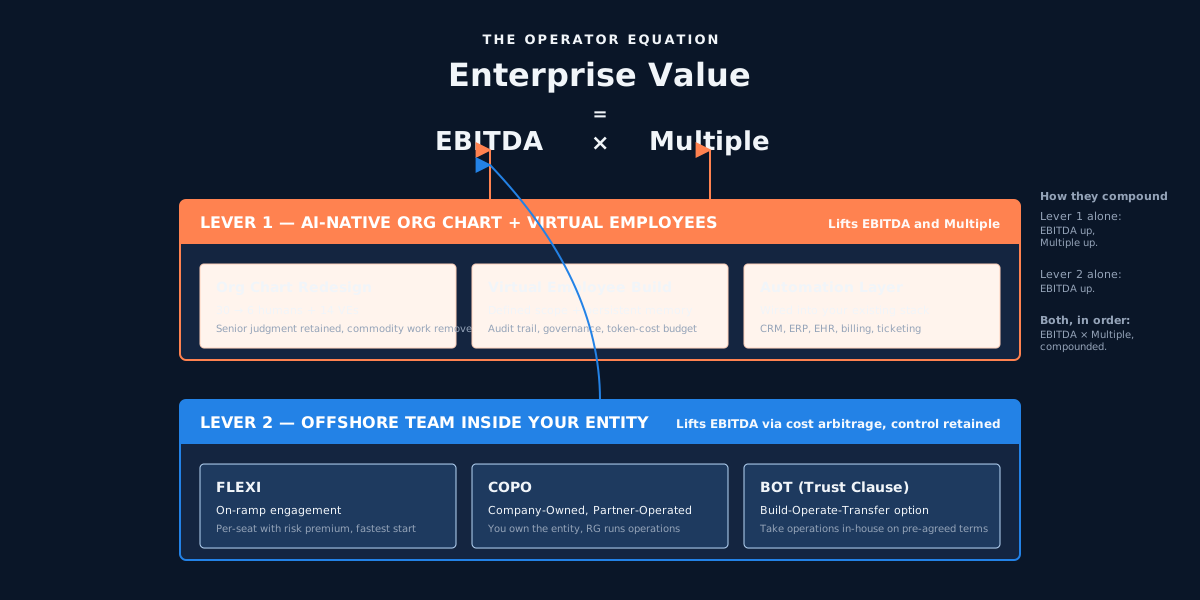
Acquirers pay more for companies with owned operations, clean data infrastructure, and AI-embedded workflows. The operational maturity commands a premium on the multiple, not just the margin. A managed GCC sells on EBITDA. A COPO GCC sells on EBITDA AND on the asset register. Different dollar of Enterprise Value at exit.
Both levers inside your entity from day one. Start with the Blueprint.
Three to five weeks. The Blueprint scopes the COPO entity structure alongside the AI-native org chart, the Virtual Employee roster, and the joint unit economics. Outcome: a build-ready plan your CFO and your board can both act on.