Both Levers Across Your Portfolio. EBITDA Today. Multiple Tomorrow.
Deploy AI-native operating models across portfolio companies, with Virtual Employees inside each portco's COPO entity and a lean human team running them. EBITDA expands in month one. The category shift from labor-cost arbitrage to tech-enabled operating leverage compounds the multiple at exit.
Scale Operations. Expand EBITDA. Own the Asset.
- AI-Native Operations + Offshore Teams across portfolio companies. EBITDA today, multiple tomorrow.
- Both levers engaged: 400 to 700 bps from labor arbitrage on offshoreable routine work, plus 100 to 300 bps from AI compounding inside each function. +0.5 to 1.5x exit-multiple premium.
- Sponsor-portfolio math at typical mid-market scale: $4M to $6M EBITDA expansion per portco per year, $40M to $60M across a 10-portco fund. Directional ranges; the Blueprint replaces them with company-specific math.
- Sequenced against the sponsor’s 100-day plan and exit window. Capital partners want models they can scale and repeat.
- Same dollar of EBITDA. Different dollar of Enterprise Value at exit.
Trusted by industry leaders


Days to Operational
Clients Served
India Offices
Years Experience

Why PE Firms Are Building, Not Renting, India Operations
The traditional playbook: negotiate a vendor contract, reduce cost per FTE, sell the company. The problem: when the acquirer runs diligence, they find operating capability they are paying a premium for actually belongs to the vendor. The acquirer discounts. The multiple compresses. The value you thought you created evaporates.
The Ownership Premium
Two companies, same sector, comparable EBITDA. One valued at 8.5x. The other at 10.5x. The difference: who owned the operating intelligence. That delta is the price of renting your operating core.
The AI Accelerant
Before Virtual Employees, vendor dependency was leaving money on the table. With Virtual Employees running, it is transferring advantage every month. Every month of vendor-processed workflow is a month of persistent memory and training data accumulating inside a vendor’s systems, not inside your portfolio company’s entity. The companies that own their Virtual Employees will own the multiple expansion. The ones renting them are funding their replacement.
The Hold Period Math
On a 5-year hold: Prove-Expand-Compound maps directly to your timeline. Prove the model in months 1-6. Expand in months 6-12. Compound for 3.5 years before exit. The GCC is not a cost line. It is EBITDA that compounds and a multiple expander at exit.
Three Questions Operating Partners Ask. We Have Answers.
We run a suite of Virtual Employees inside our own business. We have built the playbook against our own scars before we shipped it to portfolio companies.
Token costs
Every Virtual Employee in a deployment has a cost-per-action budget in the Blueprint. Compute is a line item, not a surprise. Your CFO models against unit-of-work, the same way they model the rest of the operating cost base.
Governance
Every Virtual Employee has a named human owner inside the portfolio company, an approval workflow, and an audit trail. A buy-side operator reviewing diligence sees the same view your ops team sees.
Persistent memory
The memory layer each Virtual Employee holds is on the portfolio company's data, inside the portfolio company's entity. No vendor accumulation. When the buyer acquires, they acquire the memory.
Easy to say. Hard to do. That is the work.
How Ownership Changes Exit Economics
When you build a managed GCC, you improve EBITDA. When you build a COPO GCC, you improve EBITDA and create a balance-sheet asset. The difference matters at exit.
Year 1: The Improvement Looks the Same
Both approaches deliver cost reduction, standardized processes, and operational efficiency. EBITDA improves 8-12%. On your P&L, they look identical.
Year 3: The Divergence Emerges
Managed GCC: Operational improvements live in the income statement. The buyer pays for the EBITDA lift. But if you lose the vendor relationship, the capability erodes. The improvement is temporary. Buyers price this in: normalized EBITDA multiple.
COPO GCC: Operational improvements live in the income statement AND the asset register. Your subsidiary employs 75 people. Your data, your processes, your culture drive the operations. The buyer acquires a mature, owned operating capability. The improvement is structural. Improvement is owned, not rented. Buyers pay for both the EBITDA lift and the asset on your balance sheet. Multiple expansion is common: 0.5-1.5x premium over normalized multiples.
Managed Services
EBITDA Impact
8 to 12%
Exit Multiple
Normalized
Structural Moat
Vendor-dependent
RG COPO
EBITDA Impact
8 to 12%
Exit Multiple
+0.5 to 1.5x Premium
Structural Moat
Owned asset
Same dollar of EBITDA. Different dollar of Enterprise Value.
The valuation premium of operational ownership compounds through the hold period. The question is not whether India ops improve EBITDA.
It is whether that improvement is temporary (vendor-managed) or structural (owner-managed). The Blueprint converts these directional ranges into company-specific math in 3 to 5 weeks.
Chapter 6 of Control Compounds walks through the exact deal math. Read Chapter 6: Exit Economics
The Ranges Behind Both Levers
Per-portco EBITDA-margin and exit-multiple ranges, plus the sponsor-level math when the thesis runs at portfolio scale.
400 to 700 bps
EBITDA margin from labor arbitrage on offshoreable routine work
+100 to 300 bps
Additional EBITDA margin from AI-enabled throughput compounding inside each function
+0.5 to 1.5x
Directional exit-multiple premium when both levers engage
$4M to $6M
Directional EBITDA expansion per portco per year at 50 offshore roles plus AI compounding inside each function.
$40M to $60M
Directional EBITDA delta per year. Before any multiple expansion is priced into the exit.
These are sector-calibrated, directional ranges. They are not a commitment about any specific portco. The Blueprint replaces them with company-specific, function-by-function math in 3 to 5 weeks.
One Model, Multiple Portfolio Companies
You do not need to figure this out separately for each holding. The operating model, the compliance infrastructure, and the talent pipeline are reusable across your portfolio. In the AI era, every month your portfolio company processes data through a vendor is a month of training data accumulating outside your governance. Owned operations mean owned intelligence.
Portfolio Assessment
We score your holdings against the GCC Maturity Index (Level 1 through Level 5). Most companies that think they have India operations are stuck at Level 2: they own the entity but the vendor owns the capability. We identify which companies benefit most and in what sequence.
First Deployment (90 Days)
Sequenced against the sponsor's 100-day plan. Start with the portfolio company that has the fewest active failure modes. COPO (Company-Owned, Partner-Operated) or FLEXI model depending on board requirements. Entity setup, compliance infrastructure, first hires, and systems integration. Operational in 90 days.
Prove and Expand
First 15-20 people prove the model works. Not 80 people proving it does not. Six months of operational track record: quality metrics, attrition data, cost benchmarks, compliance audit results. Real data for your IC memo, not projections.
Replicate Across Portfolio
The infrastructure, the talent pipeline, and the operating playbook are proven. Deploy to the next portfolio company. And the next. Each deployment is faster than the last because the model is already running. Capital partners want models they can scale and repeat. The Blueprint produces one, sequenced against your hold period.
Portfolio Assessment
We score your holdings against the GCC Maturity Index (Level 1 through Level 5). Most companies that think they have India operations are stuck at Level 2: they own the entity but the vendor owns the capability. We identify which companies benefit most and in what sequence.
First Deployment (90 Days)
Sequenced against the sponsor's 100-day plan. Start with the portfolio company that has the fewest active failure modes. COPO (Company-Owned, Partner-Operated) or FLEXI model depending on board requirements. Entity setup, compliance infrastructure, first hires, and systems integration. Operational in 90 days.
Prove and Expand
First 15-20 people prove the model works. Not 80 people proving it does not. Six months of operational track record: quality metrics, attrition data, cost benchmarks, compliance audit results. Real data for your IC memo, not projections.
Replicate Across Portfolio
The infrastructure, the talent pipeline, and the operating playbook are proven. Deploy to the next portfolio company. And the next. Each deployment is faster than the last because the model is already running. Capital partners want models they can scale and repeat. The Blueprint produces one, sequenced against your hold period.
What Portfolio Companies Build in India
The functions depend on the vertical. Here is what we deploy most frequently across PE-backed holdings.
Healthcare Services
Revenue cycle management, clinical coding, claims processing, provider operations, HIPAA-ready compliance infrastructure. Teams run Virtual Employees for medical coding triage, claims adjudication routing, and clinical documentation first-pass review, with certified coders and clinicians approving every decision. The Virtual Employees train on your claims data, inside your entity, with persistent memory across months. Not a vendor's.
Financial Services
KYC/AML operations, trade processing, loan servicing, risk analytics, regulatory reporting. Teams run Virtual Employees for KYC first-pass identity verification, sanctions screening, trade reconciliation, and Basel/CCAR/DFAST input assembly. AML analysts approve every SAR. Settlement operators clear every break. Reporting leads certify every submission.
Technology
Software engineering, QA, cloud/DevOps, data engineering, ML, application support. Captive teams running Virtual Employees alongside them for code-review triage, test scaffolding, documentation drafting, and L2 ticket triage. Engineers own every merge. SREs own every root cause. The institutional knowledge stays inside your team, not a vendor's.
Business Services
Finance and accounting, procurement, customer operations, back-office functions. Teams run Virtual Employees for invoice processing, three-way match, AR aging, lockbox reconciliation, and exception triage. Senior accountants own every close. Controllers own every cash decision. Persistent memory holds your GL system, your vendor patterns, your customer profiles.
Insurance
Claims processing, underwriting operations, actuarial support, policy administration. Teams run Virtual Employees for FNOL intake triage, fraud-signal flagging, submission ingestion, and rating-engine pre-population. Adjusters approve every coverage. Underwriters own every bind. Credentialed actuaries sign every indication.
Compliance-Heavy Industries
Pharma (pharmacovigilance, clinical data management), legal ops (document review, contract management), any vertical where regulatory infrastructure is the differentiator. Teams run Virtual Employees for PV case triage, MedDRA pre-coding, eCTD module assembly, contract risk flagging, and audit-evidence collection. Certified PV officers approve every case. Counsel owns every contract decision. Auditor sign-off remains human.
Built for Exit from Day One
Every GCC we build is designed to be an asset at exit, not a liability. The acquirer should see the India center as a reason to pay more, not a risk to discount.
What Acquirers Want to See
What We Build
Control Compounds
Written for PE operating partners and CEOs of portfolio companies. The book covers the GCC Maturity Index (where your holdings actually stand), the 8 failure modes that kill India operations, the COPO ownership model, and the Prove-Expand-Compound framework that maps to your hold period. If you are evaluating India operations for your portfolio, start here.
Read the BookA PE-Backed Healthcare Services Firm Built a 200+ Person India Center Under COPO
A PE-backed US healthcare services company needed to scale delivery capacity without linear US headcount growth. Traditional outsourcing created vendor dependency that would compress multiples at exit. They chose the COPO model: their entity, their employees, Reliable Group operating the infrastructure.
The India center launched in 90 days. Within the first year, the operation scaled to support multiple end clients through the company's own service delivery model.
The India team now handles revenue cycle management, clinical operations, and provider services at quality levels matching US benchmarks. The operation forced more organizational maturity in one year than the previous decade.
At exit, the acquirer sees an owned, operational India center with documented processes, clean entity structure, and 12+ months of quality track record. That is a multiple expander, not a cost line.
Exit Economics With Both Levers Engaged
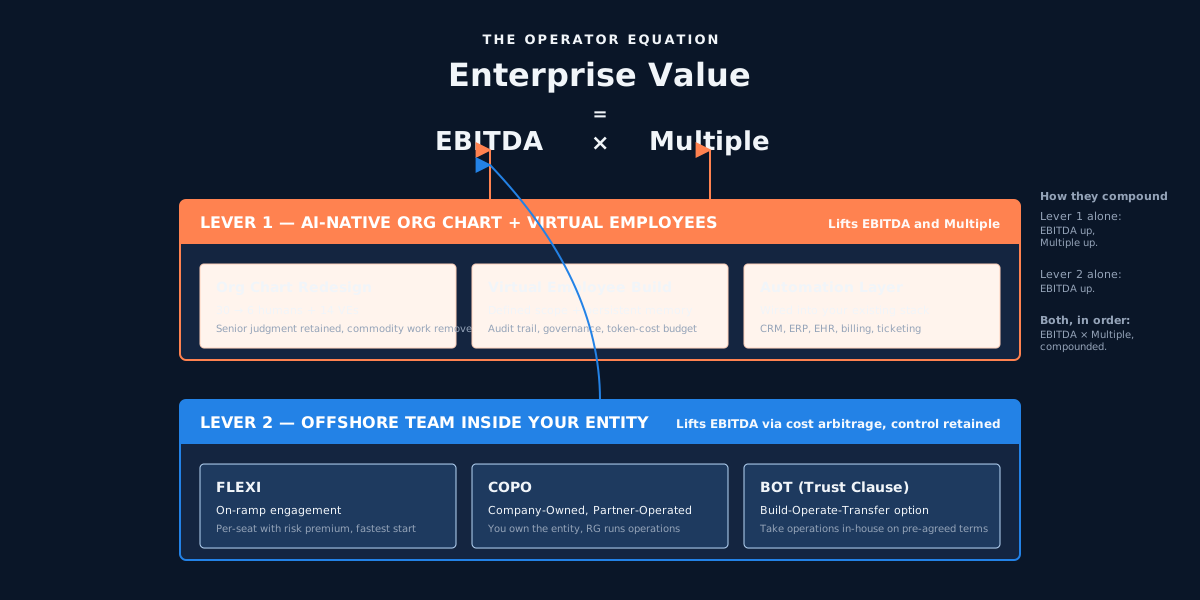
Most PE operating partners running an AI strategy in 2026 are paying a vendor to accumulate institutional knowledge inside the vendor's platform, then watching the buyer underwrite the operation as a labor line on EBITDA, not as tech-enabled services on revenue multiple. That is one lever. We run two.
The portfolio company that ends the hold period with both levers engaged shows up at exit with EBITDA expanded against a lower operating cost and a multiple expanded against a different category. The math is structural, not promotional.
Virtual Employees + AI-Native Org Chart
The functions inside the portfolio company that drive AI-native EBITDA expansion are predictable: portfolio finance operations (consolidations, AR follow-up, FP&A reporting), deal-stage diligence operations (data-room population, KPI tear-downs, comparable-deal libraries), and post-close 100-day plan execution (workflow automation, vendor consolidation, pricing-discipline rollouts). We redesign the org chart, build the Virtual Employees, and stand them up inside a lean human team that owns judgment and exceptions. EBITDA expansion comes from the routine processing time the Virtual Employees absorb and the persistent memory that compounds inside the portfolio company's entity, not the vendor's.
Offshore Team Inside Your Entity
A standardized backoffice across the portfolio, built inside each portco's COPO or Flexi entity, is where the cost-structure savings sit. Shared compliance frameworks, shared recruiting infrastructure, shared facility footprint, shared HR and payroll.
Each portco owns its own entity and its own team. The PE firm gets repeatable economics across the portfolio without the captive headache.
Combined Math (Directional)
Directional range when both levers are engaged inside a portco at typical mid-market scale: 25 to 40 percent reduction in fully-loaded operating cost across the functions in scope, three to five points of EBITDA margin expansion, and a category shift in the diligence narrative from labor-cost arbitrage to tech-enabled operating leverage. That category shift is what supports a revenue multiple at exit, not just an EBITDA multiple. Multiple-arbitrage logic: a 1x or 2x revenue multiple lift on a $50M revenue portco is worth more than the underlying EBITDA expansion in most exit scenarios.
How the Blueprint scopes this for your portfolio company: org chart redesign, Virtual Employee roster, offshore team plan, joint unit economics, 12-month implementation plan. See the AI-Native Org Chart for the operational picture.
Functions We Support, Decisions We Do Not Make
An operating partner that will not tell you where its authority ends is not a partner your compliance team can sign off on.
Functions we support
- Pre-close operating diligence on a target: workflow suitability, offshore feasibility, management capacity and the value bridge.
- Post-close operating design: the AI-native org chart, Virtual Employee specifications, the offshore team plan and joint unit economics.
- Build and operate inside the portfolio company entity under COPO, BOT or FLEXI.
- A repeatable portfolio playbook, so the second and third portco cost less to scope than the first.
- Pre-exit operating documentation a buyer can diligence: control evidence, process documentation and a transferable operating chassis.
Decisions we do not make
- We do not price the asset or opine on valuation. How a buyer underwrites the operation is the buyer’s decision.
- We do not provide quality-of-earnings, tax, legal or accounting opinions, and we do not substitute for the advisers who do.
- We do not make hiring, termination or compensation decisions. Those sit with portco management under their own entity.
- We do not sit on the board or take governance decisions on the sponsor’s behalf.
- We do not guarantee multiple expansion. Operating improvement is what we build; how the market prices it is not ours to promise.
Responsibilities split three ways on a portfolio engagement: the sponsor sets the thesis and the capital plan, portco management owns the decisions and the people, and Reliable Group designs and operates the operating layer underneath.
Questions Your Reviewers Will Ask
Under COPO the portfolio company owns the India entity and employs the team from day one, so the data, the IP and the institutional memory sit inside the portco. Under BOT, Reliable Group builds and operates first and transfers on pre-agreed terms. Under FLEXI, Reliable Group employs the team during the proof period and the work product is assigned to the client throughout.
It transfers with the company, because it was never ours. The org chart, the Virtual Employee specifications, the prompt and policy libraries and the accumulated memory belong to the portco. That is the difference between an owned operating layer and a vendor relationship a buyer has to unwind during diligence.
Each portfolio company is a separate entity with separate systems, separate access controls and separate teams. There is no shared data environment across portcos, and no portco data is used to train or tune anything used for another. Where a sponsor wants a shared playbook, what is shared is the method and the templates, not the data.
None that we would put on a badge. Reliable Group does not hold SOC 2, ISO 27001 or CMMC certification, and HIPAA has no certification regime. What we provide instead is reviewable security architecture and data-handling documentation, and control design specified by the portfolio company’s own compliance function. Our Trust Center sets out the position in full.
Usually yes, and the sequencing matters. We map what the incumbent holds, what transfers cleanly and what has to be rebuilt, then plan the transition against the contract’s notice and exit terms rather than against an idealised timeline. Where an incumbent holds the institutional knowledge, recovering it is part of the scope.
Pre-Transaction Value Creation. Three to Five Weeks.
The Blueprint becomes the spine of the value creation plan you take to the IC and the artifact your buyer's diligence team takes as proof. Same business. Same hold period. Different Enterprise Value.