Redesign the Org Chart Before You Build
In three to five weeks we map the work, identify the judgment and exception paths, define the governed AI roles, and produce the org chart and unit economics your team can implement. The output is the artifact your CFO can model, your COO can staff against and a buyer can diligence.
- One function, three to five weeks, paid. The deliverable stands on its own whether you build it with us, internally, or with someone else.
- Function-by-function teardown: which workflows become governed AI roles, which stay human, and the stated reason for each.
- You get the before and after org chart, a build-ready specification per AI role, the human-team scope, and the unit economics.
- It needs roughly 12 to 18 hours of your team’s time across the engagement. That number is on this page because underestimating it is the usual reason these slip.
- Pairs with Virtual Employee Build (building the roles) and Automation Layer Implementation (wiring them into your systems).

When This Engagement Is the Right One
Saying no to the wrong version of this work is most of what makes the right version worth the fee. Both columns are honest, and the right-hand one has cost us engagements.
Commission this when
- You already know which function to redesign, and someone senior owns the outcome.
- The function has enough volume that the shape of it matters, not just the staffing of it.
- You need a design your CFO can model and a buyer or board can examine, not a strategy deck.
- You are willing to have the answer be "fewer AI roles than you expected" if that is what the work shows.
- A transaction, a budget cycle or a hiring decision gives the design a deadline.
Do not commission this yet when
- The function is mid-reorganisation. Redesign the shape once, not twice.
- Nobody senior owns the function, so there is no one to hand the design to.
- The real question is a systems migration. Fix the data path first; the org chart cannot route around it.
- You need a specific headcount number to justify a decision already made. We will not reverse-engineer one.
- Policy in the function is unresolved. A governed AI role cannot be scoped against a rule nobody has written.
If it is the wrong time, we say so on the call rather than after the invoice. The wrong version of this engagement produces a document nobody implements.
Three to Five Weeks, Week by Week
Five weeks when the function spans several systems or a regulated review is involved. Three when it is one team on one stack.
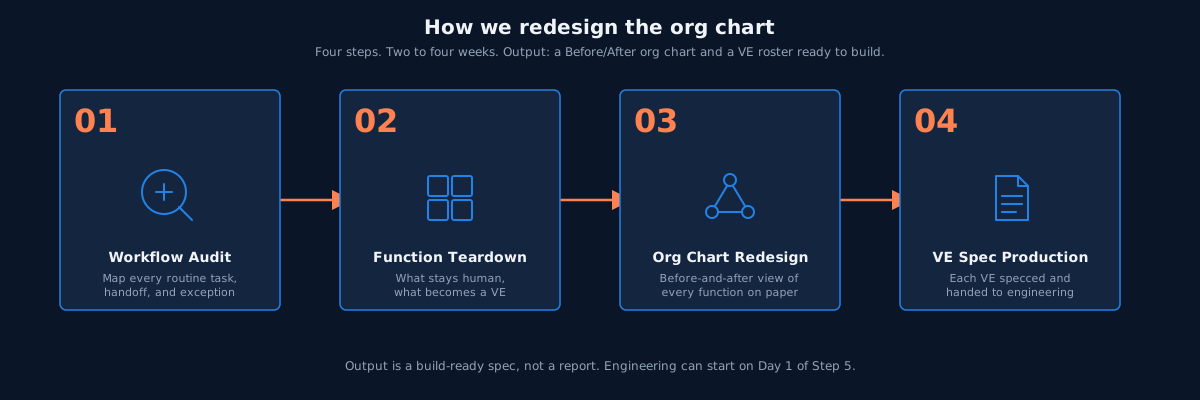
Week 1: Teardown
Structured interviews and observation with the operators who actually do the work, not only their managers. We map who does what, how often, on which system, against which service level, and where exceptions really go, which is rarely where the process document says.
Week 2: Workflow mapping and scoring
Every workflow written down as decisions, inputs, outputs and dependencies, then scored against the four conditions for becoming a governed AI role. The score carries its reasoning, so a decision can be challenged later on the substance.
Week 3: The redesign
The before and after org chart. Every line on the new chart has a scope, a named owner and a stated reason it stays human or becomes an AI role. This is the week the answer stops being a range.
Week 4: Specifications and economics
A build-ready specification for each governed AI role covering scope, owner, approval path, audit trail, context architecture, cost ceiling and rollback. Alongside it, the unit economics modelled from your observed volumes.
Week 5 if needed: Review and handover
Walk-through with the function owner, the CFO’s team and, where the workload is regulated, your compliance lead. We adjust the design against their objections rather than defending it, then hand over the files.
What You Receive, and What Each One Looks Like
Six artifacts. Each description says what the thing physically is, because "workflow audit" on a service page could mean anything from a spreadsheet to a slide.
Workflow teardown
Preview: a per-workflow document, typically 15 to 30 workflows for a function of 30 people, each with the decision points, the systems touched, volumes and where exceptions actually route. Written so someone outside the team could follow it.
Scoring against the four conditions
Preview: a single sheet, one row per workflow, four scored columns (defined boundary, durable context, volume, auditability) plus the reasoning and the resulting call. This is the document people argue with, which is the point.
Before and after org chart
Preview: two diagrams and a role table. Every role on the after chart carries a scope line, a named owner and the reason it is human or AI. Used directly in board and diligence material without rework.
Specification per governed AI role
Preview: two to four pages each, covering scope and boundary, the named human owner, the approval path, the audit-trail format, the context architecture, the monthly cost ceiling and the rollback procedure. Build-ready as handed over.
Human-team scope
Preview: one page per surviving human role. Judgment points, exception ownership, relationship work, and supervisory scope over the AI roles. Enough for a recruiter to write a job description from.
Unit economics
Preview: a model with your volumes as inputs, showing compute cost range per AI role, fully loaded cost per remaining human, and the combined run rate against the current operation. Assumptions stated on the sheet, not in a footnote.
See the Format Before You Commission One
A worked sample with dummy data
A redacted version of the full deliverable set for one function: the teardown, the scoring sheet, the before and after chart, one complete role specification and the unit-economics model.
Request the sampleSent as a redacted worked example with dummy data, usually the same day. We ask who it is for so the example matches your function rather than a generic one.
Inputs, Time and What Is Out of Scope
The most common reason a design engagement slips is that the client time it needs was never stated. So here it is.
Access we need
Read access or guided walk-throughs of the systems the function uses; existing process documentation however out of date; volume data for the last 12 months; the current org chart with fully loaded costs; and any written policy the function operates under.
Time from your team
Roughly 12 to 18 hours in total across the engagement. Typically 6 to 10 hours from operators in week 1, 2 to 3 hours from the function owner in weeks 2 and 3, 2 hours from finance for the economics, and a 90-minute review at the end. Spread over weeks, not blocked out.
Decisions only you can make
Which function is in scope; who the accountable owner is; your risk posture for automated work in that function; and whether an offshore team is in play, because it changes the design.
Out of scope
We do not build the AI roles in this engagement, integrate systems, procure tooling, run change management with your staff, or provide legal, tax or employment advice on any restructuring the design implies. Each of those is separate work, and we will say which.
Standalone, or Inside the Blueprint
Same design method either way. The difference is how much of the operation is in scope and whether an offshore plan is part of the answer.
Standalone AI-Native Org Chart Design
Choose this when you know the function and only need the design
- One function, three to five weeks.
- You handle the build internally or with another partner. The specifications are written to be handed over.
- No offshore or entity component. The design assumes your current staffing geography.
- Cleanest option when a specific function is the bottleneck and the rest of the operation is settled.
Inside the Blueprint
Choose this when the decision spans an operation or a transaction sets the clock
- The org chart plus the governed AI roles plus the offshore plan plus the combined unit economics, scoped together.
- Includes which work moves into a COPO, Flexi or BOT entity, and what that entity costs to stand up and run.
- Produces a sequenced implementation plan across the operation rather than one function.
- Where most operators start, because deciding the AI design and the staffing design separately tends to produce a design that does not close.
Commissioning the standalone engagement first and the Blueprint later is a normal path, and the design work is not repeated or re-billed.
What the Design Actually Buys You
The org chart is the artifact every other operating decision flows from. Getting the shape right first makes the build, the hiring and the integration ordinary work rather than a two-year patching exercise.
Where routine-processing time falls is modelled from your own observed volumes during the engagement and stated with its assumptions. We do not carry a general percentage into a new function, because the answer moves with workflow density and exception rate.
The output is your asset. The teardown, the specifications and the economics are yours, and no future work is gated behind them.
Every recommendation is defensible in a diligence room, because the scoring shows its reasoning and the economics show their assumptions.
Most AI advisory work stops at a recommendation. This stops at a build specification, which is a different document and a harder one to write.
Related Services
Virtual Employee Build
Builds the governed AI roles this engagement specifies. Bounded access, durable context, auditable outputs, production deployment.
Learn moreAutomation Layer Implementation
Connects the roles to your CRM, ERP, EHR, billing and ticketing systems. Identity, permissions, exception routing and rollback.
Learn moreThe Blueprint
The whole operation rather than one function: org chart, AI roles, offshore plan and combined unit economics in one engagement.
Learn moreBoth Levers Engaged
This is a Lever 1 service. The org chart and the role specifications are the architecture. They pair with GCC Setup and Talent Acquisition on Lever 2: the team built inside your own COPO or Flexi entity that runs the operation alongside the governed AI roles.
The Blueprint scopes both in one engagement, so you do not end up with an org chart you cannot staff or a team working against a chart that was not designed for governed AI roles in the first place.
Start with the Blueprint.
Three to five weeks. Paid engagement. Both levers scoped together.