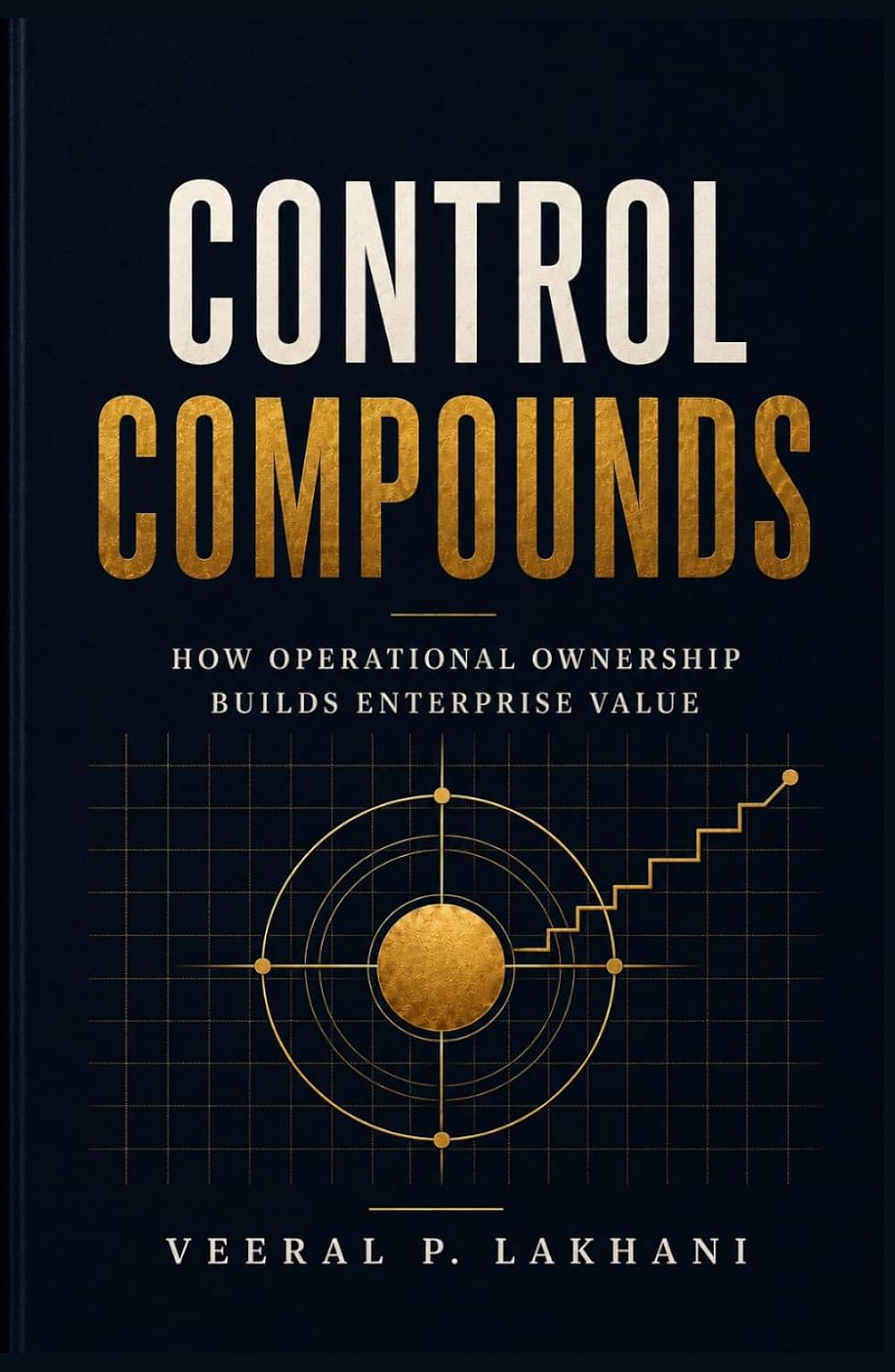
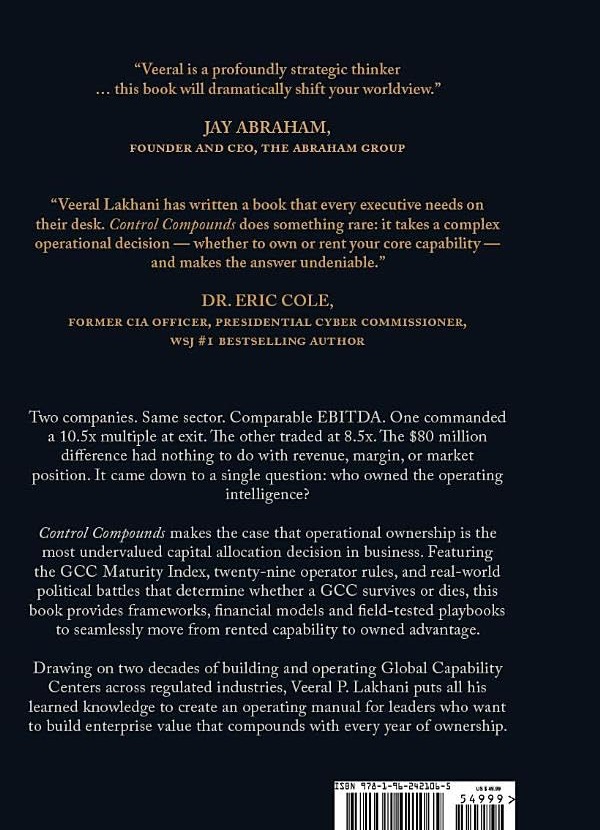
Control Compounds

Operational Ownership in the AI Era

The book that makes the case for both levers. Why renting your AI deployment from a vendor forfeits the asset that makes next year's AI three times better than this year's. How the AI-native org chart and the offshore team inside your entity, together, compound value instead of accumulating it somewhere else.

By Veeral Lakhani, CEO Reliable Group. Print-ready May 15, 2026.

The Thesis

Either Lever Alone Leaks. Both Together Compound.

The institutional residue your operation produces every day is the asset. Exception patterns. Prompt libraries.

Fine-tuning data. The judgment of which AI tool to use when, and what "good" looks like in your industry. That residue compounds.

Year three is three times more valuable than year one. Year five looks like an unfair advantage to anyone who tries to enter your market.

The question is not whether AI will produce the residue. It will. The question is where the residue lands.

If your AI runs on a vendor's infrastructure, trained on a vendor's data pipeline, governed by a vendor's policies, the residue accrues to the vendor. Your team produces the signal.

Their model gets smarter. Three years in, your switching cost is no longer the contract.

It is the operational memory that sits on their side of the line. You cannot unship that.

The fix is structural, not contractual. You need both levers.

The AI-native org chart redesigned from zero, with Virtual Employees handling the routine work and a lean human team making the calls. And the offshore team inside your entity, hiring on your books, your data, your governance.

Either lever alone leaks. Both together compound. That is the whole argument.

Four Excerpts

Read the Argument, in V's Words

Each excerpt maps to a decision an operator is making in the next twelve months.

Chapter 4: Operational Residue in the AI Era

Institutional Residue

The institutional residue your operation produces is the asset. The buyer prices it. The sponsor either owns it or rents it.

Walk through any operation that has been running for three years and you will find residue. Not exhaust. Residue. The exception your team learned to handle on a Tuesday in 2023, the workaround for that one provider’s claim format, the prompt the analyst quietly tuned because the default kept missing the edge case. Nobody wrote it down. Everyone uses it.

Before AI, residue was institutional knowledge. It lived in heads. Some of it walked out at exit interviews. Most of it stayed because the team stayed. After AI, residue is data. The prompt the analyst tuned is a prompt library. The exception your team learned is a labeled training example. The judgment about which tool to use when is a routing rule that, written down once, runs forever. Residue stopped being a property of people and started being a property of systems.

Where the system lives determines where the residue lands. If the system is a Virtual Employee running inside your entity, on your data, under your governance, the residue stays. If the system is a vendor’s tool, the same residue accrues to the vendor. The choice is not whether to use AI. The choice is which side of the line the residue lands on.

Read the full chapter

Chapter 2: The GCC Maturity Index

The Level 2 Trap

Most companies that walk in believing they are at Level 3 score back at Level 1 or 2. The trap is the AI retrofit on top of vendor-managed operations.

Most companies that walk into the conversation believing they are at Level 3 score back at Level 1 or 2. The Level 2 Trap is the gravity well. Companies plateau at Level 2 because Level 2 looks like progress on day one (we have an entity now) and feels like ownership on day three hundred (we have a team now).

The trap closes when the company tries to retrofit AI on top of the Level 2 operation. The vendor’s playbook is still underneath. The new AI sits on top of an org chart that was designed for a vendor-managed reality. The result is a Level 2 operation with AI bolted to the side. The dependency deepens. The exit becomes harder, not easier.

The way out is not retrofit. The way out is redesign. That is what both levers, together, are for.

Read the full chapter

Chapter 16: Building the Machine

The AI-Native Org Chart

Same throughput. Six humans plus fourteen Virtual Employees. The institutional residue stays inside the operator’s entity, not the vendor’s.

A traditional thirty-person back office has a director, two managers, five team leads, and twenty-two individual contributors doing a mix of routine and judgment work. The shape was designed in 2019. Most of it predates 2019. The AI-native version of the same function has six humans and fourteen Virtual Employees.

The six humans are not the survivors of a layoff. They are a deliberate selection. One director who owns the function and the relationships. One manager who handles exceptions and escalations. Four senior individual contributors who handle judgment work. The team is smaller than what came before. It is also more senior, more experienced, and more expensive per head. That is the point.

The fourteen Virtual Employees handle the work that did not require judgment in the first place. The work is in deciding which roles become Virtual Employees and which stay human. That is not a software question. That is an operating model question. It is the whole reason the Blueprint exists.

Read the full chapter

Chapter 11: The Launch Sequence

Prove-Expand-Compound

Prove (30-60 days). Expand (months 3-12). Compound (year 2+). The launch sequence that maps to a 5-year hold period.

Most failed GCC rollouts failed in the first six weeks. Not the first six months. The first six weeks. The reason is almost always the same: the buyer started with a number of seats instead of a question. "How many people do we need in India" is the wrong first question. The right first question is, "What is the smallest version of this operation we can build right, prove, and learn from."

Prove (30 to 60 days). A small AI-native cell. Five to ten humans, two or three Virtual Employees, one workflow scoped tight enough that success or failure is unambiguous in eight weeks. The point is not the savings. The point is the answer to "Can we do this."

Expand (months three through twelve). Move inside the client’s entity. The COPO structure takes over. The team transfers to the entity. The Virtual Employees scale alongside them. New workflows come online quarterly. Compound (year two and beyond). The institutional residue starts to show up. On a typical PE hold, the compounding window is the last three and a half years before exit. That is the window the buyer pays for. Start with ten people and a hypothesis. Not a hundred and a prayer.

Read the full chapter
Who This Book Is For

Five Reader Profiles

The frameworks land differently depending on which one is yours.

PE Operating Partners

You are running portfolio AI deployment as a strategy, not a project. The book is the playbook for turning each portco’s backoffice into a compounding asset that lifts the exit multiple, not just the EBITDA line. The Maturity Index, the two-lever build sequence, and the exit-economics chapter are written for your conversation with the portco CEO.

Mid-Market CEOs Going Through Majority Recap

You are six to eighteen months from a transaction. The buyer’s banker is going to tell a story about your operation. You decide which story. A backoffice cost line is an EBITDA-multiple story. A tech-enabled services firm is a revenue-multiple story. The book lays out how to ship the second story before the diligence call.

Investment Bankers Running Sub-Vertical Sell-Side

You run a sub-vertical M&A practice. The same operating profile shows up across the founders you take to market. The buyer’s first question is always the same: what makes this asset different from the last five we underwrote in this sub-vertical? The book is the framework you can endorse before sending the operator into the diligence room. Three to five weeks of pre-transaction scope. Six deliverables that sit cleanly inside the CIM. Not a consulting workstream that runs into your process.

Healthcare Operators

You run RCM, clinical documentation, or compliance operations under regulatory pressure that compounds every year. The book makes the case for bringing the operational intelligence home into a COPO entity, with Virtual Employees that train on your data inside your governance, and a senior India team that operates the layer the regulators audit.

Enterprise Operators with Plateaued India Centers

You set up a captive five years ago. It works. It also stopped getting better four years ago. You are at Level 2 on the Maturity Index. The book maps the move from Level 2 to Level 4. The shift is not more tools. It is the org chart redesigned, the Virtual Employees designed in, and the governance rebuilt to make AI native to the operation.

Get Early Access

Submit the Form. Get a Chapter Excerpt in 48 Hours.

We will send a chapter excerpt within 48 hours and notify you when print-ready ships May 15, 2026.