We measure how work actually gets done, and what fixing it is worth.
Trace is Reliable Group's own instrument. It records how work really happens on the machines you designate, finds where the time goes and what belongs with AI, automation or people, then measures the same work again after we have changed it.
Deployed transparently, on the machines you designate, with a named owner inside your organisation. Architecture and security documentation available for your team to review.

Discovery is guesswork. Trace is evidence.
Every operational initiative starts the same way: interviews, process maps, and workshops. People describe their work from memory, and decisions get made on those descriptions. The problem is that how people describe their work and how they actually do it are rarely the same thing.
And when an experienced team member leaves, the gap becomes permanent. Years of institutional knowledge, the workarounds, the exceptions, the judgment calls, walk out the door with them.
We built Trace because we refused to keep designing operations on hearsay. It observes real work as it happens and turns it into process documentation that reflects how your operation actually runs rather than how it was once described.
Described vs. actual
Interview-based discovery captures what people remember and choose to share, not what they actually do all day.
Knowledge walks out the door
When a long-tenured team member resigns, you typically have weeks to capture years of institutional knowledge. Handover documents never come close.
Point-in-time snapshots go stale
Traditional assessments describe one moment. Operations change every month, and the report on the shelf does not.
Hours are not the point.
Hours
what we measure
Cost out
of the business
EBITDA
goes up
Multiple
applied to it
Enterprise value
what it is worth
Hours
what we measure
Cost out
of the business
EBITDA
goes up
Multiple
applied to it
Enterprise value
what it is worth

Arithmetic, not a forecast. Take out one million dollars of run-rate cost, at eight times, and you have made eight million dollars of enterprise value.
We have rebuilt a platform from a twelve times exit multiple to nineteen before. What is new is that every step of it is now measured instead of argued.
Buying.
Underwrite the number the business could earn, not the one it reports.
Holding.
Prove the cost actually came out. The EBITDA is real, and dated.
Selling.
An evidence trail a buyer's diligence cannot discount. Unsubstantiated savings get discounted at exit. Measured ones do not.
Our entire process runs on Trace
Reliable Group works in three stages. Trace is the instrument underneath all of them, so decisions in the engagement are grounded in how your operation actually behaves, not how anyone describes it.
Diligence
Know before you commit.
Before you acquire, invest, or commit to an operational initiative, Trace gives you an empirical read on how the business actually operates: where the real work happens, where the friction lives, and how much of it is ready for AI, automation, or a global capability center team. Weeks of observation replace months of assumptions.
Blueprint
Design from evidence.
The Blueprint is the operational design for your initiative: the workflows, the organization, the financial model. Built on Trace, it starts from captured reality instead of interview notes. Your experts spend their time validating findings, not describing their jobs, and the design inherits none of the guesswork.
Build & Operate
Prove the change.
Reliable Group builds and operates your team inside your own entity, equipped with AI. Trace stays on as the measurement layer: run one month per quarter, it shows exactly how work has changed, so improvement is demonstrated quarter after quarter, not asserted in a report.
Trace one instrument, end to end
Diligence
Know before you commit.
Before you acquire, invest, or commit to an operational initiative, Trace gives you an empirical read on how the business actually operates: where the real work happens, where the friction lives, and how much of it is ready for AI, automation, or a global capability center team. Weeks of observation replace months of assumptions.
Blueprint
Design from evidence.
The Blueprint is the operational design for your initiative: the workflows, the organization, the financial model. Built on Trace, it starts from captured reality instead of interview notes. Your experts spend their time validating findings, not describing their jobs, and the design inherits none of the guesswork.
Build & Operate
Prove the change.
Reliable Group builds and operates your team inside your own entity, equipped with AI. Trace stays on as the measurement layer: run one month per quarter, it shows exactly how work has changed, so improvement is demonstrated quarter after quarter, not asserted in a report.
One instrument, end to end. The evidence that starts the engagement is the same evidence that proves it worked.

How Trace works
Capture
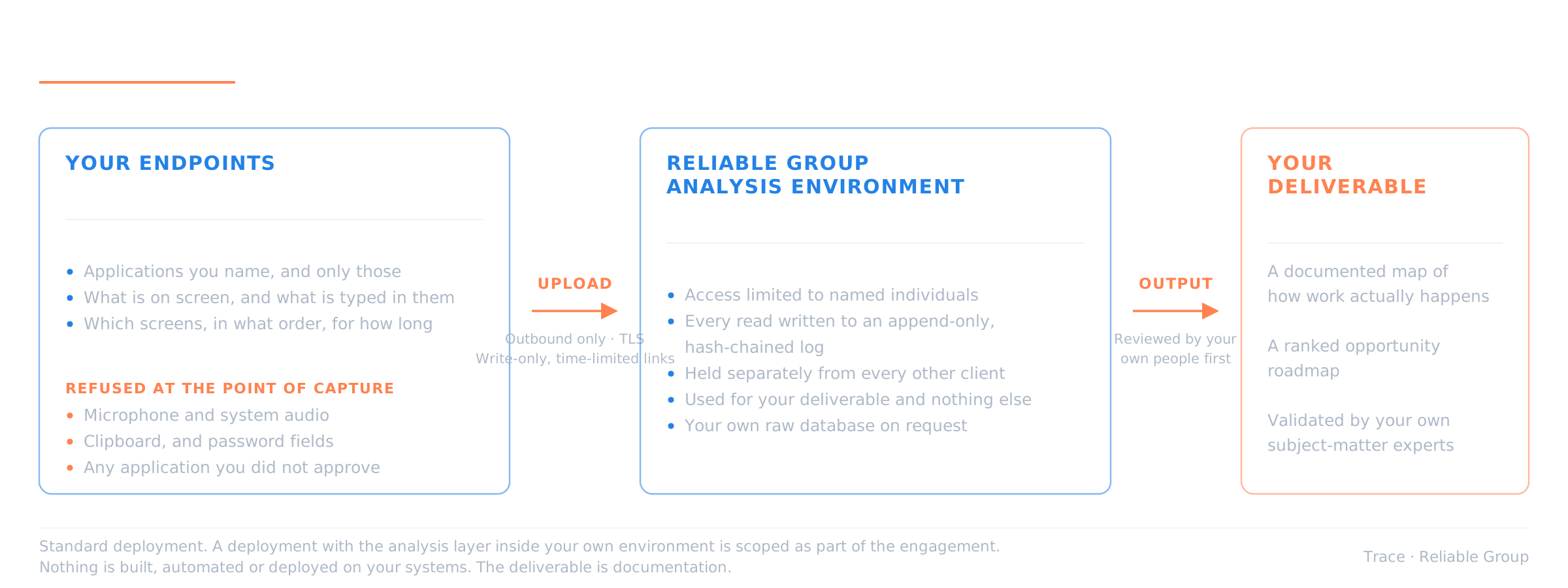
Trace's workflow capture engine, built and maintained by Reliable Group, runs locally on the machines your team designates inside your own client-controlled environment. It records how work actually happens: the applications used, the steps taken, the handoffs between systems.
Scope
You name the applications Trace records. Anything outside that list is refused at the point of capture, so it never enters the record at all. Password fields are excluded. Microphone, system audio and clipboard capture are switched off.
Transfer
What is captured is encrypted in transit and uploaded to Reliable Group's environment, where our analysis layer turns it into your deliverable. Access is limited to named authorised individuals, and every read of your data is recorded in an append-only, hash-chained log. Your data is held separately from every other client's and is never used to produce anyone else's work.
Understand
Reliable Group's analysis layer aggregates the captured work across team members, removes the noise, and synthesizes it into a clear picture of your real workflows: what gets done, how often, by whom, and where the friction lives.
Rank and act
Every workflow is stack-ranked into three lanes: best handled by AI, best handled through automation and integration, and best handled by your global capability center team. Your subject-matter experts validate each call. You get an evidence-based roadmap, not a slide deck of opinions.

Scoped at the source. Logged on every read.
Trace was engineered for organisations where privacy and compliance are non-negotiable, and the controls are stated plainly enough for your security team to test them.
You choose what is in scope.
Trace records only the applications you name. Anything outside that list is refused at the point of capture rather than filtered out afterwards, so out-of-scope material never enters the record.
What is switched off, stays off.
Microphone and system audio capture are disabled. Clipboard capture is disabled at source, so clipboard content is never read from the operating system at all. Password fields are excluded from text capture.
Every read is logged.
Access to your data is limited to named authorised individuals, and every read through our analysis layer is recorded in an append-only, hash-chained log. Altering, truncating or removing an entry is detectable.
One client, one record.
Your data is held separately from every other client's. It is used to produce your deliverable and nothing else. Reliable Group builds and maintains the entire capture and analysis stack on an MIT-licensed open-source foundation, compiles and signs its own build, and can demonstrate the provenance of that build on request.

The technical review package
Your IT and security teams receive the architecture overview, the endpoint fact sheet and the scope agreement, then a joint session that closes any open items against the specific release you would deploy.
See the Trust CenterWhat you walk away with

A living map of your operations
A permanent, searchable record of how your teams actually work. Ask it questions. Get accurate answers. It keeps learning as your operation evolves.
An evidence-based opportunity roadmap
Every repetitive workflow ranked for AI, automation, or your global team, validated by your own experts, prioritized by effort and return.
Institutional knowledge that stays
Knowledge capture applied to the judgment, exceptions and workarounds of your most experienced team members, preserved before they are lost and available to everyone who comes after.
Where Trace changes the outcome
You are about to commit capital
An acquisition or an operational investment is on the table. Trace gives you an empirical read on how the business actually runs before you decide, in weeks, without a single workshop.
A key team member is leaving
You have 30 days before 15 years of knowledge walks out the door. Trace captures their final weeks of real work with zero handover burden on them, and turns it into a permanent institutional record.
You know AI can help. You do not know where.
Instead of guessing at use cases, Trace shows you empirically which workflows are ready for AI, which need integration work, and which belong with your global capability center team.
Common questions
That depends on which deployment you choose. In the standard configuration, Trace captures to a local database on each machine and that record is uploaded to Reliable Group's environment, where our analysis layer produces your deliverable. That transfer is how the analysis is made. Where you need the analysis to run inside your own environment instead, we scope and quote that as part of the engagement. Either way, three things hold: access is limited to named authorised individuals, every read of your data is recorded in an append-only, hash-chained log, and your data is held separately from every other client's and used only for your work.
Screenshot capture is configurable per deployment. When enabled, screenshots move through the same pipeline as everything else: uploaded to Reliable Group's environment, held separately from other clients' data, subject to the same access controls, retention schedule and access log.
The main control is scope. You name the applications Trace records, and anything outside that list is refused at the point of capture. Within scope, structured secrets such as API keys, tokens, connection strings and payment card numbers are removed on the device before anything is written. That pass is early-stage and it is not de-identification: it does not remove names, email addresses or free text. We say so plainly, and we provide the architecture documentation for your security team to verify it.
Reliable Group does. The capture and analysis stack is built and maintained by our engineering team on an MIT-licensed open-source foundation. There is no third-party vendor in your data path and no outside telemetry.
Trace is deployed transparently, with a named internal owner, on machines your organisation designates, and everyone whose machine runs it knows it is running. It does analyse how each individual works, under their own name, because that is what makes the work documentable and automatable. It is not used to score, rate or rank people against one another, and your own team members validate every finding before it counts. The purpose is to take the repetitive work off them.
A typical starting point is one department, a small set of machines, and a defined capture window of 30 to 60 days. Your IT and security teams are involved from the start, and you walk away with a documented operational map and a ranked opportunity roadmap, plus a clear decision point on whether to expand. The client determines the appropriate lawful basis and employee notice. Incidental third-party information is addressed through scope minimisation, configurable screenshot capture, restricted access, limited retention and a quarantine procedure for material captured outside the intended scope.
Trace is deployed as part of a Reliable Group engagement rather than sold as standalone software. If you want the evidence without the guesswork, the conversation starts with what you are trying to decide: an acquisition, an operational initiative, or a team you want built.
Stop guessing how your company works.
One instrument from diligence to proof. Scoped to the applications you name, logged on every read.