

HOW WE BUILD
Automation first, then AI, then people for judgment.
Your AI operating partner for mid-market healthcare: rules-based automation for the volume, AI for suitable unstructured work, people accountable for decisions.

THE DEFINITION
What does AI-native mean when an auditor asks?
A department built in a set order: rules-based automation first, AI for suitable unstructured work, people for judgment and accountability. Every step is logged, so an audit asks for a trail you already have. It does not mean more software. Clinical decisions stay with your clinicians.
- Defined inputs, auditable outputs
- A named owner for every decision
- Your data, your governance
- Clinical decisions stay clinical
Four kinds of work that stay with people
Judgment
Decisions that need context the system does not have, or where a wrong call costs more than a review.
Exceptions
The cases that do not fit the pattern. The agent surfaces them, a person resolves them.
Relationships
Clients, members, providers, payers and auditors. Anything where the work is the relationship.
Escalations
Work routes to a person on set triggers: a missing document, a dollar threshold, a rule conflict or a member complaint.

ONE WORKFLOW, ILLUSTRATIVE
One prior authorization, before and after
An illustrative scenario, not a client result. Today every step is done by hand. Rebuilt, rules-based automation takes intake and record pulls, AI reads notes against policy and drafts the letter, and exceptions route to a named person. A clinician decides.
- Exceptions route to a named person
- Every case logged and monitored
- Run cost tracked per case
- A spend ceiling with an alert
Four tests before work goes to an agent
Defined workflow
A documented start, a documented end, and a success criterion that can be judged without interpretation.
Context that stays
Case history and past decisions live in your systems, so the next case starts with them and nothing leaves with a person.
High volume
The work happens often enough to justify the build against its run cost per case.
Auditability
Every output can be logged, reviewed and audited, and the trail survives the engagement.

THE AI-NATIVE ORG CHART
Cost to serve that climbs with every new claim, member or client
Most organizations add AI tools to a department shaped before the tools existed. The hours barely move, so cost still tracks volume. We redesign the department: a smaller team and a set of agents, each with a named owner, a reviewer and a person who takes the exceptions.
- People keep judgment and relationships
- Agents run the defined workflows
- Automation moves work between systems
- The chart defines what gets built

GOVERNANCE
Who answers when an agent gets it wrong?
Before an agent runs a single case, five answers are written down: who owns it, what it may do, what it logs, what it keeps and who signs off. That is what your auditor, your compliance lead and your board will ask to see.

FIVE FUNCTIONS
Five functions where backlog, cash and audit risk sit
In each function the routine volume moves to automation and agents, and the discovery shows how much added volume they absorb before you hire. People keep the judgment calls, the disputes and the sign-offs.
- Automation sorts and routes the volume
- Agents compile, validate and follow up
- People take disputes and sign-offs
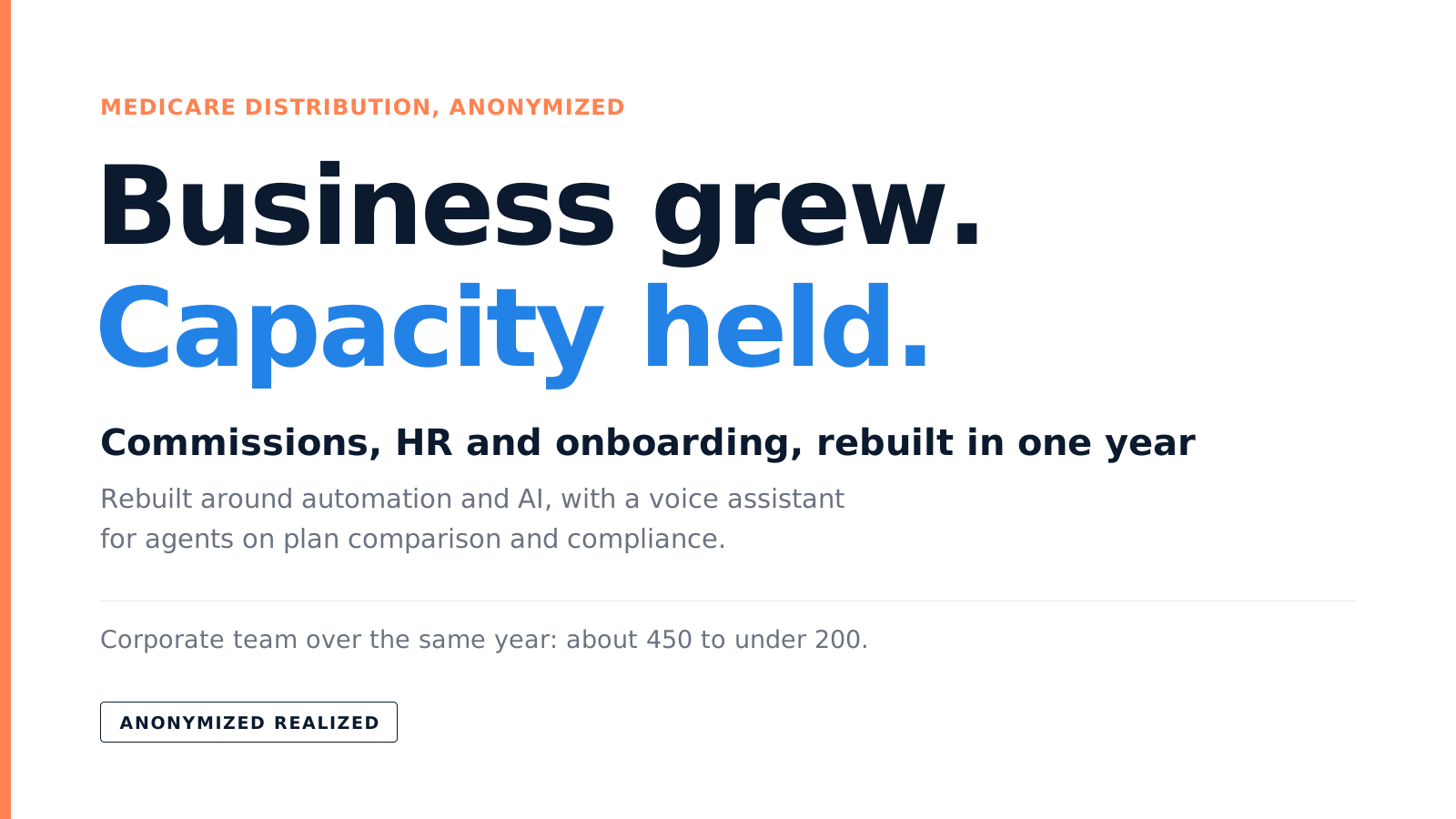
Medicare distribution, anonymized
Healthcare services
Sales capacity held and the business grew while commissions, HR and onboarding were rebuilt
A field marketing organization placing Medicare plans for 225,000+ lives through roughly 1,500 agents. Reliable Group rebuilt commissions, HR and onboarding around automation and AI, and gave agents a voice assistant for plan comparison and compliance. Sales capacity held and the business grew through the year, while the corporate team went from about 450 to under 200.
Grew, capacity held
One year: the business grew and sales capacity held. The corporate team went from about 450 to under 200.
One anonymized engagement in Medicare distribution. Shown for the operating model, not as a promised outcome.
- Growth and sales capacityanonymized realized
What transfers: The operating model this page describes: defined workflows run by automation and AI agents, with a smaller team on exceptions and decisions.
Where AI efforts quietly break
AI spend nobody budgeted.
Usage costs grow with volume unless someone caps them. Each agent runs against a cost per case, a ceiling and an alert.
Operations that cannot pause for a rebuild.
We start with one department, inside the systems you already run. Your team keeps working and deciding while we rebuild around it.
Pilots that never get past the demo.
The pilot ran beside the old process, so nothing changed. We redesign the workflow, the staffing and the ownership together.
We run this way ourselves
We do not recommend this from theory. We run our own recruiting, compliance and finance this way: defined inputs, logged outputs, a named owner at each decision and our data in our systems, so we know where it breaks before it touches your queue.
Next step
Stop guessing how your operation works.
Tell us which department eats the most hours. We will say candidly whether measuring it is worth it.