

For field marketing organizations and insurance distribution
Unclaimed commissions, late chargebacks, agents not ready to sell.
We measure your commissions, contracting and compliance hours, then rebuild and run that work as your AI operating partner.

Where the hours go
Carriers cut commissions; back office cost did not move.
Some MA plans went non-commissionable for 2025. Revenue per policy fell; statement, contracting and ticket work did not.
Commissions carriers owe that nobody claims.
Commissions and overrides arrive in every carrier format. Automation checks each policy against book of business, queues disputes, nets chargebacks.
Agents leave over commissions nobody can explain.
Missing-commission tickets wait on someone reading the statement. Agents get the statement line, any hour; disputes go to your team.
Recruited agents cannot write until contracting clears.
SureLC packets stall on NIPR license gaps or E&O; AHIP certificates get chased. Automation flags each gap and pulls RTS by product.
Every AEP means temporary staff and a backlog.
Certification season, AEP each fall, then MA OEP chargebacks January through March. Automation takes repeat volume; your team works exceptions.
Audit exposure sits in calls nobody reviewed.
Reviewers can only sample calls. AI screens each MA sales call for the TPMO disclaimer, Pre-Enrollment Checklist and SOA scope.

What we build, and what we leave alone
Your agents keep selling. Licensed work stays licensed.
We rebuild the back office: statements reconciled to book of business and comp grid, RTS pulled on schedule, every MA sales call screened. Agents keep every beneficiary conversation; your compliance officer keeps CTM complaints, misconduct allegations, audits and every finding.
- Automated: statements, RTS, chargebacks
- AI: call screening, agent tickets
- People: disputes, findings, escalations
- Commissions lead approves disputes and pay
Medicare distribution, anonymized
Direct: this segment
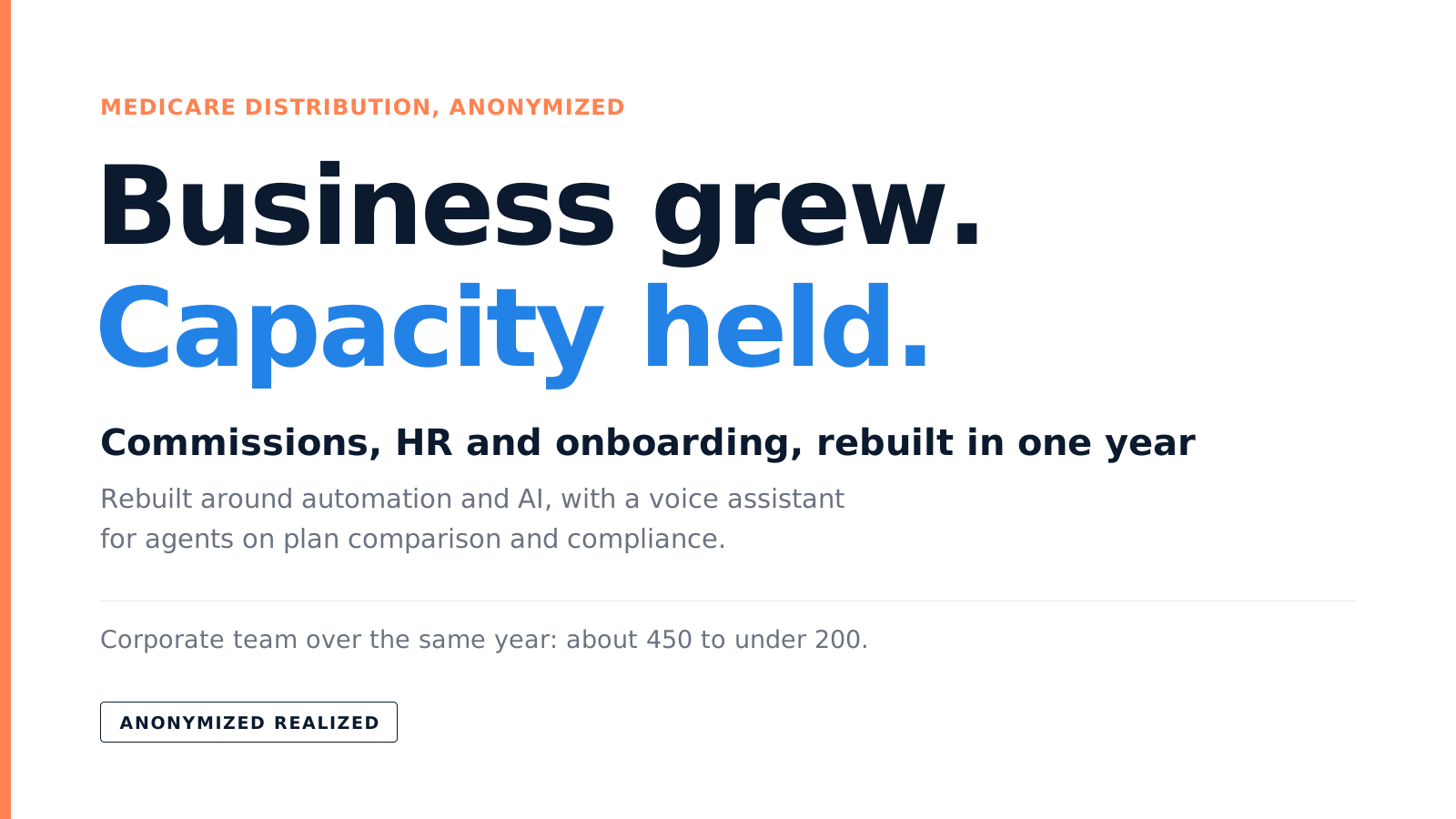
Commissions, HR and onboarding rebuilt while the business grew
A field marketing organization placing Medicare plans for 225,000+ lives through roughly 1,500 agents. Reliable Group rebuilt commissions, HR and onboarding around automation and AI, and gave agents a voice assistant for plan comparison and compliance. Sales capacity held and the business grew through the year, while the corporate team went from about 450 to under 200.
Grew, capacity held
One year: the business grew and sales capacity held. The corporate team went from about 450 to under 200.
An FMO back office we rebuilt. The client is not named.
- Growth and sales capacityanonymized realized
What transfers: Commissions, agent onboarding and HR rebuilt around automation and AI, people kept on disputes. Contracting, RTS and call review share the same records.
Questions FMO leaders ask
A fixed fee for one department, over six to eight weeks. You get a workflow map and a fixed-price proposal for the first build, then decide: build it yourself, have us build and run it, or stop there. There is no obligation to continue.
In lines your finance team already tracks: carrier commissions and overrides recovered through disputes, chargebacks netted as statements post, and back office hours removed. Discovery measures one department and prices each rebuild before you commit. Recoveries are tracked in your own commission records.
It is built not to. Agents keep their quoting tools, carrier enrollment platforms and SureLC logins; the build works behind them. Discovery runs outside certification season, AEP and the MA OEP chargeback wave, usually spring, and the build is sized for July through March.
Yes, through agency-level access you control and the files carriers already deliver: commission statements, book of business reports, RTS reports, SureLC requests and NIPR data. We never use agent credentials, and we work within each carrier's portal terms.
Usually, because each statement is checked as it posts. The build works from your actual hierarchy, overrides, splits and transfers, and applies the MA rules: initial or renewal, like or unlike plan changes, rapid-disenrollment chargebacks, prorated recoveries. Your commissions team approves every dispute.
For MA sales and marketing calls, since October 1, 2026, at least six years, down from ten: audio for the first three, audio or complete transcripts after. We index and file recordings to that schedule; your compliance officer owns the policy.
Sources for the rules and deadlines on this pagechecked November 1, 2026
- Some carriers stopped paying agent commissions on certain MA plans in some markets for the 2025 plan year. Fortune, December 2, 2024, checked November 1, 2026
- Medicare AEP runs October 15 to December 7, and the MA Open Enrollment Period January 1 to March 31. Medicare.gov, joining a plan, checked November 1, 2026
- For MA, agent compensation is paid as initial or renewal, like and unlike plan changes are treated differently, and it is recovered in full on a plan change in the first three months (with listed exceptions), prorated otherwise. CMS, 42 CFR 422.2274(a) and (d)(5), checked November 1, 2026
- Agents selling MA must be licensed and appointed under state law where required and trained and tested annually before plans may pay them. CMS, 42 CFR 422.2274(b), (c) and (d), checked November 1, 2026
- SureLC contracting imports license data from the NIPR PDB, and requests stall on items such as an expired license or missing E&O. SuranceBay support, producer workflow, checked November 1, 2026
- On MA sales calls, the TPMO disclaimer is said before any benefits are discussed. CMS, 42 CFR 422.2267(e)(41), checked November 1, 2026
- On MA telephonic enrollments, the Pre-Enrollment Checklist is reviewed before the enrollment is completed. CMS, 42 CFR 422.2267(e)(4), checked November 1, 2026
- A Scope of Appointment is documented before a personal MA marketing appointment. CMS, 42 CFR 422.2274, checked November 1, 2026
- Since October 1, 2026, MA sales and marketing call recordings are kept at least six years, down from ten: audio for three years, audio or complete transcripts after. CMS, 42 CFR 422.2274(g)(2)(ii) as amended by the CY 2027 final rule, 91 FR 17583, checked November 1, 2026
- CMS assigns most marketing complaints, including agent and broker allegations, to the plan through the Complaints Tracking Module. CMS HPMS memo, CTM standard operating procedures, January 6, 2025, checked November 1, 2026
Rules change and vary by program, state and contract. Your compliance team confirms what applies to you.
- BAA
- HIPAA
- Posture
- Notice
- BAA
- Where a department handles protected health information, we execute a business associate agreement before Trace is installed or any data is accessed.
- HIPAA
- We execute a Business Associate Agreement before any engagement that touches PHI, and PHI is accessed only inside client-controlled systems by named individuals. Our first healthcare engagement under BAA is in progress.
- Posture
- Ready and aligned describe design posture, not certification. Reliable Group does not currently hold SOC 2 or ISO 27001 certification; our teams operate inside client-certified environments under client controls.
- Notice
- We deploy Trace only after your organization has given team members the written notice required in your state; we provide the notice template.
Your client-specific workflows, data and documentation are yours. Trace is Reliable Group software, licensed under the engagement; third-party tools keep their own license terms.
Last reviewed October 2026
Next step
Stop guessing how your operation works.
Tell us which department eats the most hours. We will say candidly whether measuring it is worth it.