
FOR BEHAVIORAL HEALTH NETWORKS AND INFUSION CENTERS
Lapsed authorizations become write-offs weeks after the visit.
As your AI operating partner, we start with a fixed-fee discovery of one department, then rebuild and run authorization, billing and credentialing.

Medicare distribution, anonymized
Healthcare services
Commissions, HR and onboarding rebuilt while the business grew
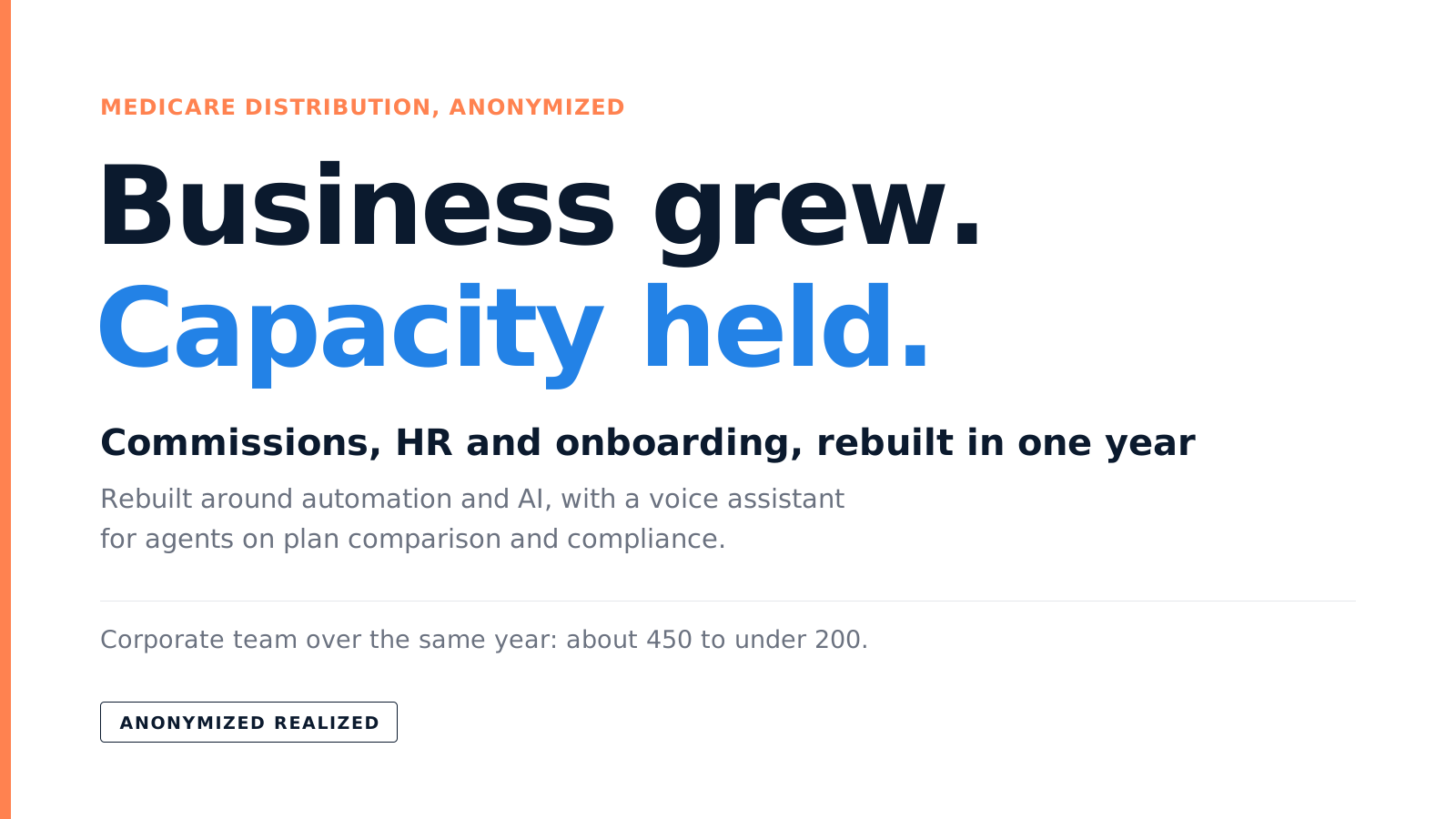
A field marketing organization placing Medicare plans for 225,000+ lives through roughly 1,500 agents. Reliable Group rebuilt commissions, HR and onboarding around automation and AI, and gave agents a voice assistant for plan comparison and compliance. Sales capacity held and the business grew through the year, while the corporate team went from about 450 to under 200.
Grew, capacity held
One year: the business grew and sales capacity held. The corporate team went from about 450 to under 200.
No behavioral health or infusion engagement is published yet; this measured case is from Medicare distribution. The discovery tests it in your department first.
- Growth and sales capacityanonymized realized
What transfers: Rules-driven tracking, reconciliation and onboarding rebuilt with automation first and people on exceptions, the pattern behind unit tracking, billing and credentialing.
Where the hours go
Sessions and chairs canceled when units run out.
Units tallied by hand, extensions filed late. Automation counts units from signed notes and stages each extension early.
Infusion: cash held up by drug-line errors.
Dose to units, Medicaid NDCs and Part B JW or JZ waste, keyed by hand. Automation checks each line before release.
Growth waits on clinicians who cannot bill yet.
CAQH files, MCO rosters and supervision rules differ by payer. Automation chases each file and tracks days to billable.

Both businesses: authorized units
Cash hangs on a unit count kept by hand.
An ABA, IOP, PHP or infusion approval names a code or level of care, the units, visits or days, and a date span. The count often lives in one coordinator's spreadsheet, and leaves with them.
- ABA units and IOP days counted
- Pre-licensed supervision rules tracked by MCO
- Medical necessity stays with UR
Common questions
One fixed fee, quoted before you sign, for a six to eight week discovery of one department. It sizes no-auth write-offs, drug margin and the staff cost of collecting. You leave with a workflow map and a fixed-price proposal for the first build. No obligation to continue.
They are different businesses sharing one administrative workflow: authorized units approved for a date span, counted as rendered and extended before they run out. Infusion adds a second, buy-and-bill: dose to billing units, NDC and waste on each claim, and invoice cost checked against the quarterly Medicare ASP file.
Usually intake and utilization review in a behavioral network, or benefits investigation in an infusion center, where a missed extension becomes a no-auth denial weeks later. Credentialing comes first if growth waits on CAQH files, MCO rosters and supervision rules; billing is the other likely start.
Yours: often Netsmart myAvatar, Qualifacts CareLogic or Credible, SmartCare or Kipu in behavioral networks; WeInfuse, Epic, athenaOne or OncoEMR in infusion, plus Availity or Waystar and hub portals. PHI stays inside your systems.
No. Medical necessity, ASAM or LOCUS level-of-care decisions, peer-to-peer, prescribing, drug preparation and administration stay with your licensed staff and UR, as does whether to give a drug that costs more than it pays. We work the administrative queues around them.
Partly. From January 1, 2026, Medicare Advantage, Medicaid and CHIP payers must decide standard requests within seven calendar days, 72 hours expedited. Drugs, including Part B, are excluded, and employer and federal exchange plans are not covered. Behavioral requests to those payers gain the clock; drug requests do not.
Yes. Compliance with the updated Part 2 rule was required by February 16, 2026, and one patient consent can now cover treatment, payment and operations. We sign a qualified service organization agreement alongside the BAA, and your privacy officer decides which SUD records we see.
Sources for the rules and deadlines on this pagechecked November 1, 2026
- From January 1, 2026, Medicare Advantage, Medicaid and CHIP payers decide standard prior authorization requests within seven calendar days and expedited ones within 72 hours; QHP issuers on the federal exchanges are excluded from the timeframes, and employer group health plans are not impacted payers under the rule. CMS, Interoperability and Prior Authorization final rule (CMS-0057-F) fact sheet, checked November 1, 2026
- CMS-0057-F prior authorization provisions exclude drugs, including Part B drugs paid under the medical benefit. CMS, CMS-0057-F fact sheet, checked November 1, 2026
- Compliance with the updated 42 CFR Part 2 rule required by February 16, 2026; one patient consent may cover all future uses and disclosures for treatment, payment and health care operations. Federal Register, 42 CFR Part 2 final rule, February 16, 2024, checked November 1, 2026
- A qualified service organization serves a Part 2 program under a written agreement to be fully bound by Part 2. 42 CFR 2.11, definition of qualified service organization, checked November 1, 2026
- On Medicare Part B claims for single-dose container drugs, JW reports discarded drug and JZ attests none was discarded (JZ required from July 1, 2023). First Coast Service Options (Medicare contractor), JW and JZ modifiers, checked November 1, 2026
- Medicaid physician-administered drug claims carry the NDC, its unit of measure and quantity alongside the HCPCS code (federal basis 42 CFR 447.520). South Dakota Medicaid, NDC billing requirement, checked November 1, 2026
- States must collect NDCs on Medicaid claims for physician-administered drugs so they can bill manufacturers for rebates. 42 CFR 447.520, checked November 1, 2026
- Most separately payable Medicare Part B drugs are paid on an ASP basis, with payment limits published each quarter. CMS, ASP pricing files, checked November 1, 2026
- CARC 197 means authorization absent and CARC 198 means authorization exceeded. X12, Claim Adjustment Reason Codes, checked November 1, 2026
Rules change and vary by program, state and contract. Your compliance team confirms what applies to you.
Sources for the rules and deadlines on this pagechecked November 1, 2026
- From January 1, 2026, Medicare Advantage, Medicaid and CHIP payers decide standard prior authorization requests within seven calendar days and expedited ones within 72 hours; QHP issuers on the federal exchanges are excluded from the timeframes, and employer group health plans are not impacted payers under the rule. CMS, Interoperability and Prior Authorization final rule (CMS-0057-F) fact sheet, checked November 1, 2026
- CMS-0057-F prior authorization provisions exclude drugs, including Part B drugs paid under the medical benefit. CMS, CMS-0057-F fact sheet, checked November 1, 2026
- Compliance with the updated 42 CFR Part 2 rule required by February 16, 2026; one patient consent may cover all future uses and disclosures for treatment, payment and health care operations. Federal Register, 42 CFR Part 2 final rule, February 16, 2024, checked November 1, 2026
- A qualified service organization serves a Part 2 program under a written agreement to be fully bound by Part 2. 42 CFR 2.11, definition of qualified service organization, checked November 1, 2026
- On Medicare Part B claims for single-dose container drugs, JW reports discarded drug and JZ attests none was discarded (JZ required from July 1, 2023). First Coast Service Options (Medicare contractor), JW and JZ modifiers, checked November 1, 2026
- Medicaid physician-administered drug claims carry the NDC, its unit of measure and quantity alongside the HCPCS code (federal basis 42 CFR 447.520). South Dakota Medicaid, NDC billing requirement, checked November 1, 2026
- States must collect NDCs on Medicaid claims for physician-administered drugs so they can bill manufacturers for rebates. 42 CFR 447.520, checked November 1, 2026
- Most separately payable Medicare Part B drugs are paid on an ASP basis, with payment limits published each quarter. CMS, ASP pricing files, checked November 1, 2026
- CARC 197 means authorization absent and CARC 198 means authorization exceeded. X12, Claim Adjustment Reason Codes, checked November 1, 2026
Rules change and vary by program, state and contract. Your compliance team confirms what applies to you.
- BAA
- HIPAA
- Posture
- Notice
- BAA
- Where a department handles protected health information, we execute a business associate agreement before Trace is installed or any data is accessed.
- HIPAA
- We execute a Business Associate Agreement before any engagement that touches PHI, and PHI is accessed only inside client-controlled systems by named individuals. Our first healthcare engagement under BAA is in progress.
- Posture
- Ready and aligned describe design posture, not certification. Reliable Group does not currently hold SOC 2 or ISO 27001 certification; our teams operate inside client-certified environments under client controls.
- Notice
- We deploy Trace only after your organization has given team members the written notice required in your state; we provide the notice template.
Your client-specific workflows, data and documentation are yours. Trace is Reliable Group software, licensed under the engagement; third-party tools keep their own license terms.
Last reviewed October 2026
Next step
Stop guessing how your operation works.
Tell us which department eats the most hours. We will say candidly whether measuring it is worth it.