

For Medicaid managed care plans
Capitation gaps and encounter rejects, worked every cycle.
A fixed-fee discovery measures one enrollment, encounter or auth queue; then we build and run it inside your plan.
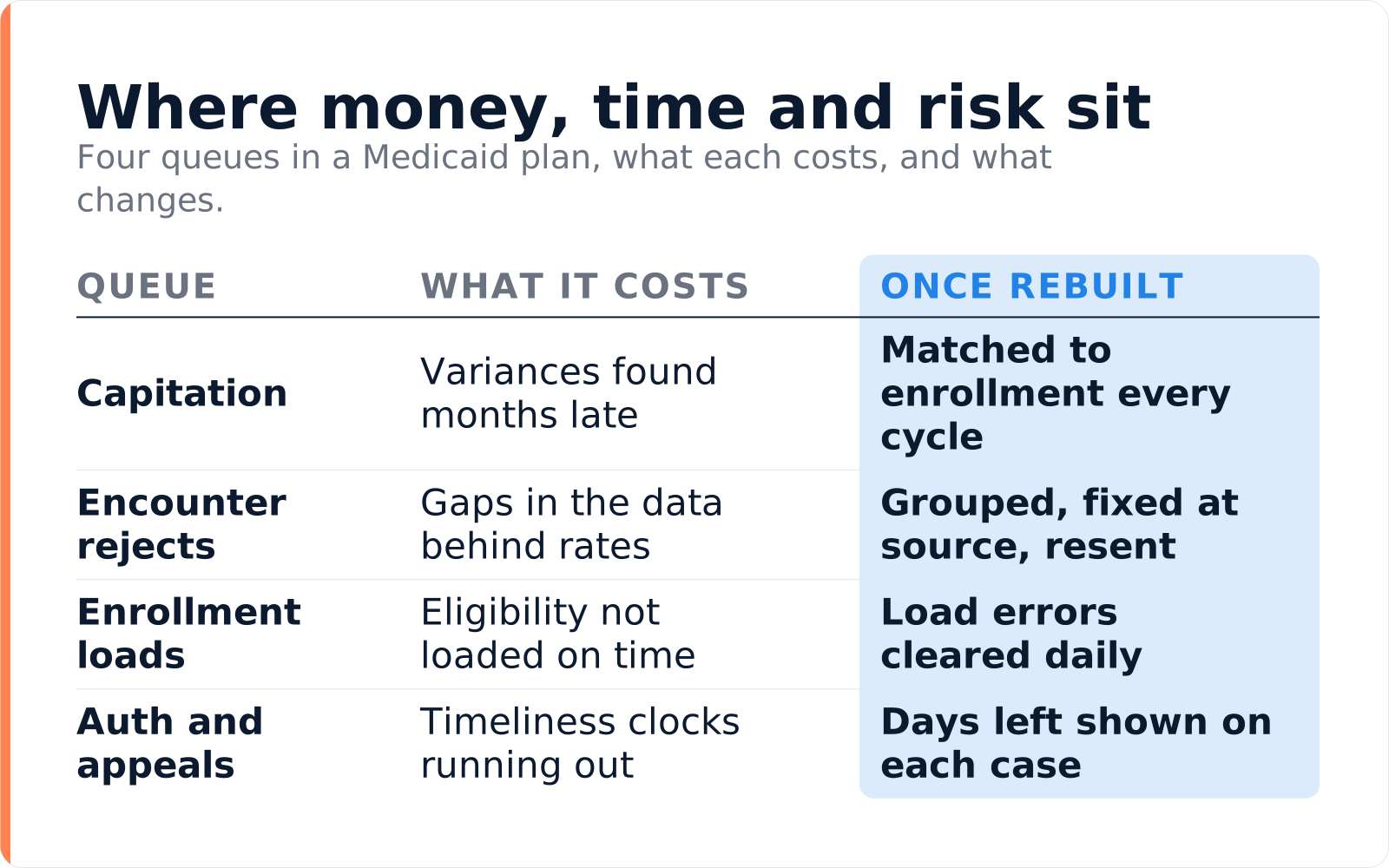
Where the hours go
Capitation owed, found months late.
Missed kick payments and retro recoupments surface late. Automation matches the 820 to enrollment by rate cell every cycle.
Rates set without the encounters the state rejected.
999, 277CA and state edit rejects grouped by code, then resent once your team fixes the source, before any withhold your contract ties to acceptance.
Auth and appeal clocks running out in a backlog.
Faxed requests, grievances and appeals logged by hand. AI reads, keys and routes; clinicians decide.
Medicare distribution, anonymized
Healthcare services
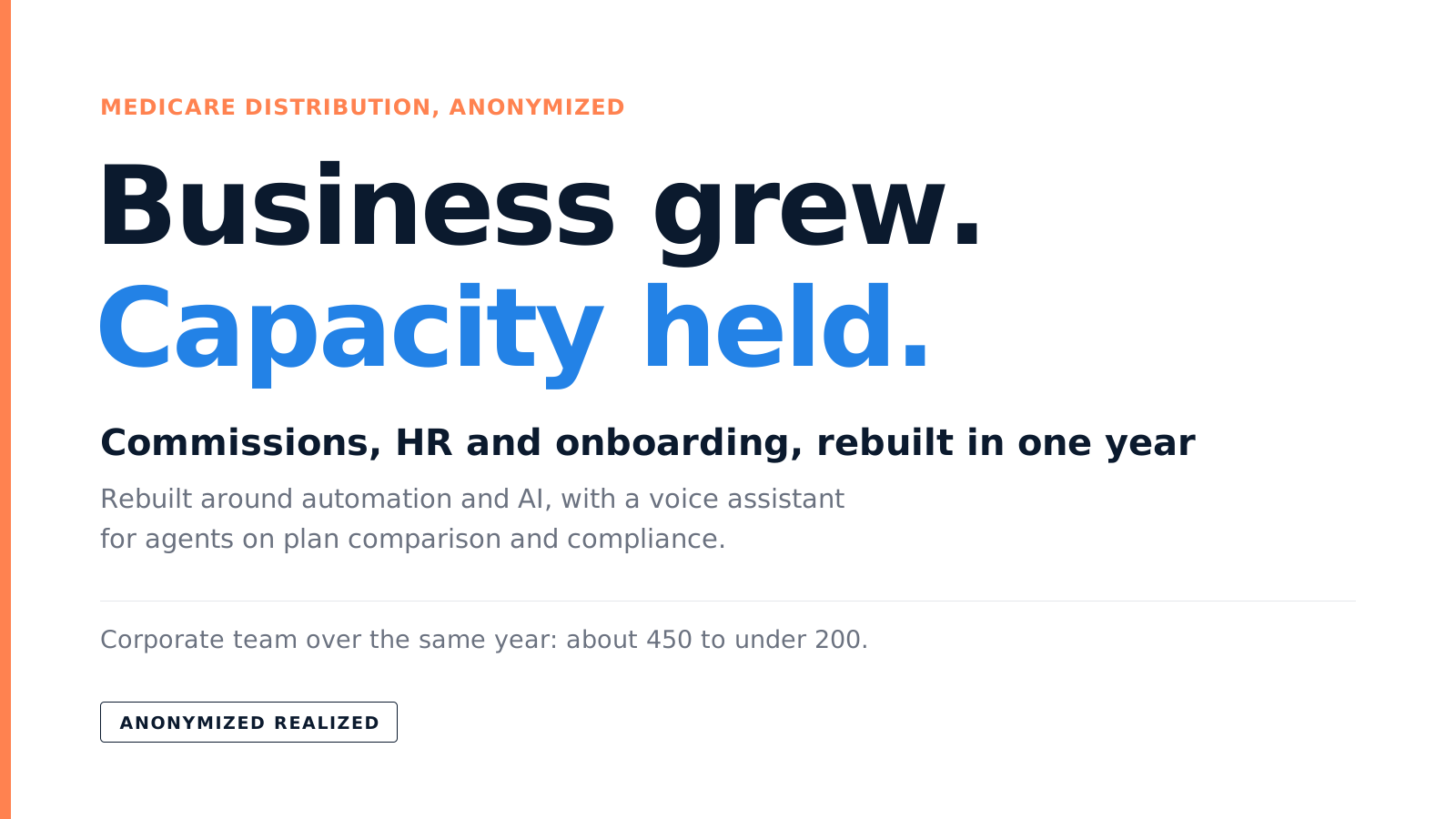
Commissions, HR and onboarding rebuilt in one year
A field marketing organization. Reliable Group rebuilt its back office around automation and AI, and the business grew through the period.
Grew, capacity held
One year: the business grew and sales capacity held. The corporate team went from about 450 to under 200.
No Medicaid managed care engagement is published yet. This Medicare distribution case shows a rebuilt back office, not what a plan should expect.
What transfers: File-driven reconciliation rebuilt with automation first and people on exceptions, the pattern behind 834, 820 and encounter work.

What we do, and what we leave alone
Capitation variances, in both directions
Across TANF, expansion, ABD, CHIP and MLTSS, an 820 short of enrollment can be capitation owed; one over it, a recoupment to come. A rejected encounter stays out of the data your rates are set on. Both wait behind 834 load errors. We take that queue.
- NCPDP encounters chased from the PBM
- Delegated rosters loaded before directory updates run late
- UM and care management untouched

What we build and run
Capacity that holds through turnover
When an analyst leaves, the state's rules leave too. We script 834 loads, 820 matching, edit checks and state report pulls, with due dates tracked; AI maps delegated rosters with a person checking. Your compliance team still signs and submits each deliverable.
Questions Medicaid plans ask
In administrative cost, unreconciled capitation and the encounter data behind your rates. Discovery is a fixed fee: one department, six to eight weeks, nothing built, no one leaves the queue. You leave with a workflow map and a fixed-price proposal for the first build.
In yours, as named individuals: Facets, QNXT, HealthRules or your platform, your EDI gateway and the state MMIS portal. File layouts follow your state companion guide, kept in configuration and retested when it changes. Submissions run under your submitter ID.
For standard requests in rating periods starting on or after January 1, 2026, decisions are due within 7 calendar days, expedited within 72 hours; covered outpatient drugs stay at 24 hours. We take intake, keying and routing; your clinicians make every medical necessity decision.
Under CMS-0057-F, plans must implement the Prior Authorization API by January 1, 2027; specific reasons for non-drug denials apply from 2026. Your IT team builds the API; neither discovery nor our queue work satisfies it. We work the fax and portal requests providers still send.
Federal rules cap standard Medicaid appeals at 30 calendar days and grievances at 90, with a possible 14-day extension; your state may set shorter. We take logging, acknowledgment letters, case files and continuation of benefits tracking, with days left shown on each case.
We sign a BAA and the subcontract terms your state contract requires under 42 CFR 438.230, including state audit rights. Where your contract limits who may access member data, or from where, discovery settles staffing first. PHI stays inside your systems.
Sources for the rules and deadlines on this pagechecked November 1, 2026
- Medicaid managed care authorization decisions: standard within 7 calendar days for rating periods starting on or after January 1, 2026, expedited within 72 hours. 42 CFR 438.210(d), Cornell LII, checked November 1, 2026
- Covered outpatient drug prior authorization requests answered within 24 hours. Social Security Act 1927(d)(5)(A), 42 U.S.C. 1396r-8, Cornell LII, checked November 1, 2026
- Medicaid managed care plans: Prior Authorization API by January 1, 2027; specific reasons for denied non-drug prior authorizations from 2026. CMS, Interoperability and Prior Authorization Final Rule (CMS-0057-F) fact sheet, checked November 1, 2026
- Standard appeals resolved within 30 calendar days and grievances within 90, as the state sets within these limits. 42 CFR 438.408(b), Cornell LII, checked November 1, 2026
- Grievance and appeal timeframes extendable by up to 14 calendar days. 42 CFR 438.408(c), Cornell LII, checked November 1, 2026
- Continuation of benefits while the plan appeal and state fair hearing are pending. 42 CFR 438.420, Cornell LII, checked November 1, 2026
- Subcontracts give the state, CMS and HHS OIG the right to audit the subcontractor. 42 CFR 438.230, Cornell LII, checked November 1, 2026
- States give the rate-setting actuary validated encounter data as base data for capitation rates. 42 CFR 438.5(c)(1), Cornell LII, checked November 1, 2026
Rules change and vary by program, state and contract. Your compliance team confirms what applies to you.
Sources for the rules and deadlines on this pagechecked November 1, 2026
- Medicaid managed care authorization decisions: standard within 7 calendar days for rating periods starting on or after January 1, 2026, expedited within 72 hours. 42 CFR 438.210(d), Cornell LII, checked November 1, 2026
- Covered outpatient drug prior authorization requests answered within 24 hours. Social Security Act 1927(d)(5)(A), 42 U.S.C. 1396r-8, Cornell LII, checked November 1, 2026
- Medicaid managed care plans: Prior Authorization API by January 1, 2027; specific reasons for denied non-drug prior authorizations from 2026. CMS, Interoperability and Prior Authorization Final Rule (CMS-0057-F) fact sheet, checked November 1, 2026
- Standard appeals resolved within 30 calendar days and grievances within 90, as the state sets within these limits. 42 CFR 438.408(b), Cornell LII, checked November 1, 2026
- Grievance and appeal timeframes extendable by up to 14 calendar days. 42 CFR 438.408(c), Cornell LII, checked November 1, 2026
- Continuation of benefits while the plan appeal and state fair hearing are pending. 42 CFR 438.420, Cornell LII, checked November 1, 2026
- Subcontracts give the state, CMS and HHS OIG the right to audit the subcontractor. 42 CFR 438.230, Cornell LII, checked November 1, 2026
- States give the rate-setting actuary validated encounter data as base data for capitation rates. 42 CFR 438.5(c)(1), Cornell LII, checked November 1, 2026
Rules change and vary by program, state and contract. Your compliance team confirms what applies to you.
- BAA
- HIPAA
- Posture
- Notice
- BAA
- Where a department handles protected health information, we execute a business associate agreement before Trace is installed or any data is accessed.
- HIPAA
- We execute a Business Associate Agreement before any engagement that touches PHI, and PHI is accessed only inside client-controlled systems by named individuals. Our first healthcare engagement under BAA is in progress.
- Posture
- Ready and aligned describe design posture, not certification. Reliable Group does not currently hold SOC 2 or ISO 27001 certification; our teams operate inside client-certified environments under client controls.
- Notice
- We deploy Trace only after your organization has given team members the written notice required in your state; we provide the notice template.
Your client-specific workflows, data and documentation are yours. Trace is Reliable Group software, licensed under the engagement; third-party tools keep their own license terms.
Last reviewed October 2026
Next step
Stop guessing how your operation works.
Tell us which department eats the most hours. We will say candidly whether measuring it is worth it.