

For regional and provider-sponsored health plans
Aging pends, capitation mismatches and prior auth deadlines.
An AI operating partner: fixed-fee discovery of one department measures where cash and hours stall; then we build and run the fixes.

Where the hours go
Pend inventory aging faster than examiners clear it.
Claims pend on auth, COB, provider-not-on-file and pricing edits. Automation does the lookups and routing; examiners decide the exceptions.
Enrollment that does not match capitation.
Medicaid 834 files and MA membership reports drift from the capitation actually paid. Matching is scripted; people work the exceptions.
Prior auth deadlines spent keying faxes.
As of 2026, MA and Medicaid clocks run from receipt while staff key faxes. AI reads each fax and flags missing clinicals.
Recoveries waiting after every retro term.
Each retro term from the TRR or state 834 means recoupments, refund requests and reprocessing. Automation finds affected claims and drafts requests.
Prompt-pay interest and rework after every change.
Fee schedule and configuration changes become reprocessing projects. Automation finds affected claims, runs adjustments through your core system and tracks interest owed.
Claims paid first that another payer owed.
Other-insurance questionnaires and Medicare Secondary Payer leads wait for research. Automation sends and tracks them and updates COB records as answers arrive.
Provider complaints that start with a roster.
Commercial lines owe directory checks every 90 days under the No Surprises Act. AI maps delegated rosters to NPPES; staff resolve conflicts.
Program audit exposure kept in a workbook.
MA appeal and grievance workbooks feed the program audit universe, where misclassification is a finding. Automation logs cases at receipt; people classify.
Risk adjustment revenue held up by rejects.
Encounter rejects from the clearinghouse, CMS and the state pile up. Automation fixes data and format rejects; coding questions go to people.

What we do, and what we leave alone
Much of your cost to serve sits between systems
A regional plan carries the core system, upgrades and audits of a much larger plan with a fraction of the team; a provider-sponsored plan adds delegated encounters from its own groups. People close the gaps to the clearinghouse, UM system, MARx, state portal and fax server. We take that work.
- Pends released, denied or routed
- Enrollment matched to capitation
- Denials stay with medical directors
- Credentialing decisions stay yours
Medicare distribution, anonymized
Healthcare services
Commissions, HR and onboarding rebuilt while the business grew
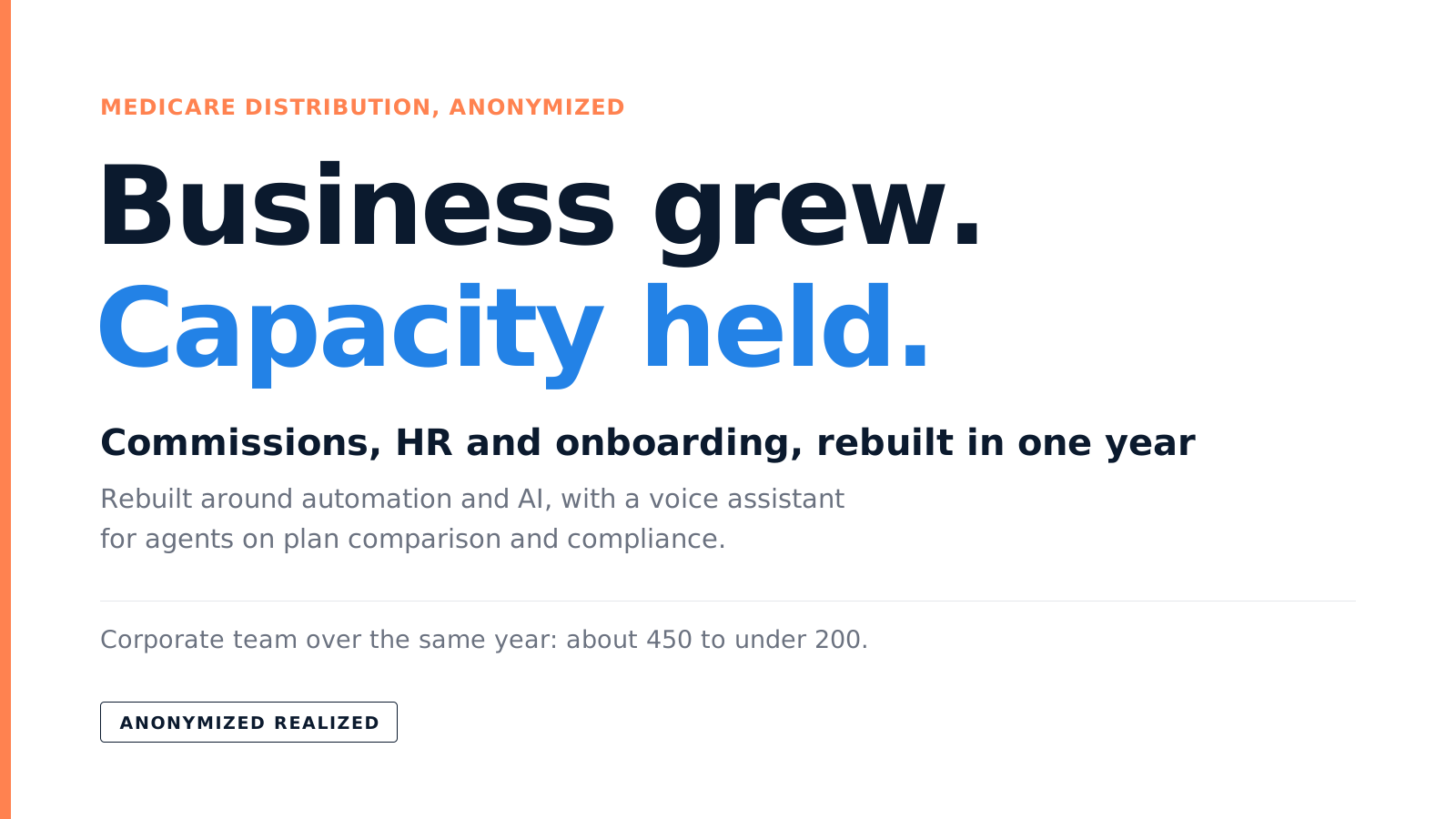
A field marketing organization placing Medicare plans for 225,000+ lives through roughly 1,500 agents. Reliable Group rebuilt commissions, HR and onboarding around automation and AI, and gave agents a voice assistant for plan comparison and compliance. Sales capacity held and the business grew through the year, while the corporate team went from about 450 to under 200.
Grew, capacity held
One year: the business grew and sales capacity held. The corporate team went from about 450 to under 200.
No health plan engagement is published yet. This case is from Medicare distribution, the nearest published work to a plan's back office.
- Growth and sales capacityanonymized realized
What transfers: Rules-driven queues rebuilt with automation first, AI for documents and people on exceptions, the same pattern a plan's pend and enrollment queues follow.
Questions regional plans ask
A queue scorecard: pend age, touches per claim, turnaround and recoveries, plus prompt-pay interest, unmatched capitation and encounter rejects, with the hours behind each. We baseline them from your own data and do not quote an improvement before measuring.
A fixed fee for one department's discovery, often the claims or enrollment unit, over six to eight weeks. You leave with a workflow map and a fixed-price proposal for the first build, and no obligation to continue. The fee is in the proposal.
The discovery measures the work your team still checks, reworks or escalates around that contract. It shows what to script, what to leave with the vendor and what to bring in house. Common starting points are the pend queue, adjustments and 834 and TRR reconciliation.
We build around your core system, not instead of it. Proposed method, confirmed in discovery: use the APIs, extracts or file loads your vendor exposes; on a hosted desktop, work from the reports and queues your examiners use. Changes go through vendor change control.
As of 2026, MA and Medicaid managed care plans owe standard decisions within seven calendar days of receipt and expedited within 72 hours; federal exchange plans are excluded. We take fax intake, case assembly and deadline tracking. Medical necessity and denials stay with your clinicians.
Only where your contracts allow it. MA plans report subcontractors that use member PHI outside the US to CMS, and some state Medicaid contracts bar work or data storage outside the US. We confirm those terms in discovery and scope each role to them.
Sources for the rules and deadlines on this pagechecked November 1, 2026
- MA and Medicaid managed care prior authorization decisions within 7 calendar days (standard) and 72 hours (expedited) from 2026, federal exchange QHP issuers excluded. CMS, Interoperability and Prior Authorization Final Rule (CMS-0057-F) fact sheet, checked November 1, 2026
- MA standard prior authorization clock runs from receipt of the request, from January 1, 2026. 42 CFR 422.568(b)(1), checked November 1, 2026
- Medicaid managed care decision clocks run from receipt, for rating periods starting on or after January 1, 2026. 42 CFR 438.210(d), checked November 1, 2026
- Group and individual coverage: directory information verified at least every 90 days, plan years from 2022 (No Surprises Act section 116). 42 U.S.C. 300gg-115, checked November 1, 2026
- MA program audits of organization determinations, appeals and grievances work from universes the plan submits. CMS, Final MAPD Program Audit Protocol training questions (December 2021), checked November 1, 2026
- Misclassified coverage requests are a Medicare program audit finding. CMS, 2023 Part C and Part D Program Audit and Enforcement Report, checked November 1, 2026
- MA enrollment reconciled against MARx Transaction Reply Reports and the Monthly Membership Report. CMS, MA enrollment reconciliation process, checked November 1, 2026
- Medicaid plans receive daily and monthly 834 enrollment files from the state. Oregon Health Authority, CCO Enrollment Reconciliation and Discrepancy Reporting Guide (2025), checked November 1, 2026
- States pay Medicaid capitation through the X12 820, including retroactive adjustments. Virginia DMAS, 820 companion guide (2022), checked November 1, 2026
- MA encounter submissions return front-end acknowledgments and MAO-002 reject reports. CMS CSSC Operations, Encounter Data Submission and Processing Guide (November 2022), checked November 1, 2026
- MA plans pay interest on non-contracted clean claims not paid within 30 days. 42 CFR 422.520, checked November 1, 2026
- MA plans report to CMS, with an attestation, subcontractors that use member PHI outside the US. CMS HPMS memo, Offshore Subcontract Data module (August 26, 2008), checked November 1, 2026
- Some state Medicaid contracts bar work or data storage outside the US. McDermott Will and Emery (July 2025), checked November 1, 2026
Rules change and vary by program, state and contract. Your compliance team confirms what applies to you.
Sources for the rules and deadlines on this pagechecked November 1, 2026
- MA and Medicaid managed care prior authorization decisions within 7 calendar days (standard) and 72 hours (expedited) from 2026, federal exchange QHP issuers excluded. CMS, Interoperability and Prior Authorization Final Rule (CMS-0057-F) fact sheet, checked November 1, 2026
- MA standard prior authorization clock runs from receipt of the request, from January 1, 2026. 42 CFR 422.568(b)(1), checked November 1, 2026
- Medicaid managed care decision clocks run from receipt, for rating periods starting on or after January 1, 2026. 42 CFR 438.210(d), checked November 1, 2026
- Group and individual coverage: directory information verified at least every 90 days, plan years from 2022 (No Surprises Act section 116). 42 U.S.C. 300gg-115, checked November 1, 2026
- MA program audits of organization determinations, appeals and grievances work from universes the plan submits. CMS, Final MAPD Program Audit Protocol training questions (December 2021), checked November 1, 2026
- Misclassified coverage requests are a Medicare program audit finding. CMS, 2023 Part C and Part D Program Audit and Enforcement Report, checked November 1, 2026
- MA enrollment reconciled against MARx Transaction Reply Reports and the Monthly Membership Report. CMS, MA enrollment reconciliation process, checked November 1, 2026
- Medicaid plans receive daily and monthly 834 enrollment files from the state. Oregon Health Authority, CCO Enrollment Reconciliation and Discrepancy Reporting Guide (2025), checked November 1, 2026
- States pay Medicaid capitation through the X12 820, including retroactive adjustments. Virginia DMAS, 820 companion guide (2022), checked November 1, 2026
- MA encounter submissions return front-end acknowledgments and MAO-002 reject reports. CMS CSSC Operations, Encounter Data Submission and Processing Guide (November 2022), checked November 1, 2026
- MA plans pay interest on non-contracted clean claims not paid within 30 days. 42 CFR 422.520, checked November 1, 2026
- MA plans report to CMS, with an attestation, subcontractors that use member PHI outside the US. CMS HPMS memo, Offshore Subcontract Data module (August 26, 2008), checked November 1, 2026
- Some state Medicaid contracts bar work or data storage outside the US. McDermott Will and Emery (July 2025), checked November 1, 2026
Rules change and vary by program, state and contract. Your compliance team confirms what applies to you.
- BAA
- HIPAA
- Posture
- Notice
- BAA
- Where a department handles protected health information, we execute a business associate agreement before Trace is installed or any data is accessed.
- HIPAA
- We execute a Business Associate Agreement before any engagement that touches PHI, and PHI is accessed only inside client-controlled systems by named individuals. Our first healthcare engagement under BAA is in progress.
- Posture
- Ready and aligned describe design posture, not certification. Reliable Group does not currently hold SOC 2 or ISO 27001 certification; our teams operate inside client-certified environments under client controls.
- Notice
- We deploy Trace only after your organization has given team members the written notice required in your state; we provide the notice template.
Your client-specific workflows, data and documentation are yours. Trace is Reliable Group software, licensed under the engagement; third-party tools keep their own license terms.
Last reviewed October 2026
Next step
Stop guessing how your operation works.
Tell us which department eats the most hours. We will say candidly whether measuring it is worth it.