

For revenue cycle management and medical billing companies
Aged AR and missed appeal windows eat your margin.
The AI operating partner for RCM companies: we start with a fixed-fee discovery of one client's book, then rebuild the work.

Where the hours go
Collections fees lost to denials worked late.
Denial queues get worked by date, not appeal deadline or dollar value. Automation ranks them; AI drafts appeals an AR specialist approves.
AR backlogs that surface in client reports.
AR teams check status portal by portal and on hold. Automation pulls electronic status first and routes rejects to the right biller.
Each new client means hiring before it pays.
New clients bring legacy AR, ERA enrollment and hand-posted remits. Automation tracks enrollment, matches remits, flags short pays where rates are loaded.
Medicare distribution, anonymized
Healthcare services
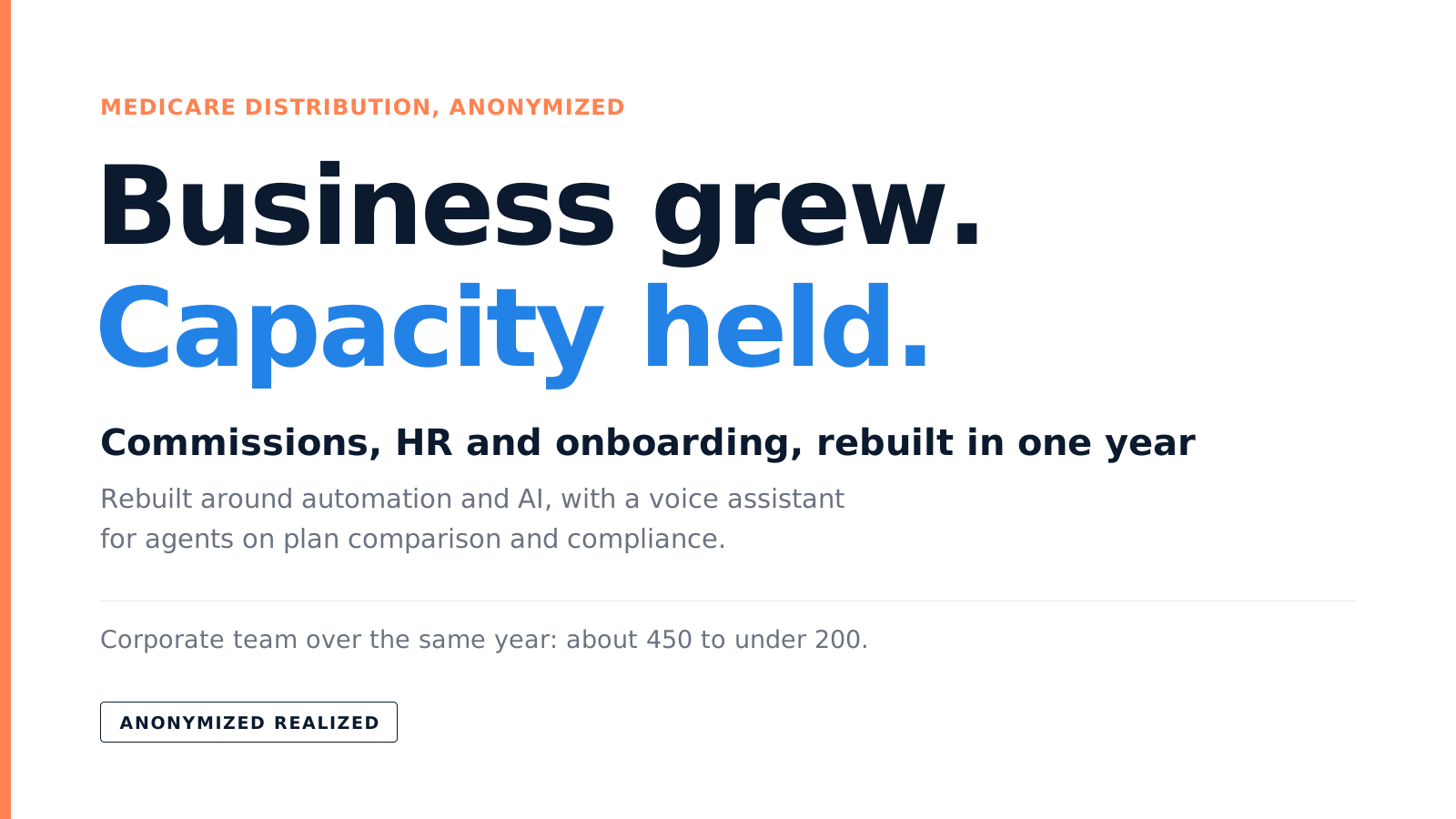
Commissions, HR and onboarding rebuilt while the business grew
A field marketing organization placing Medicare plans for 225,000+ lives through roughly 1,500 agents. Reliable Group rebuilt commissions, HR and onboarding around automation and AI, and gave agents a voice assistant for plan comparison and compliance. Sales capacity held and the business grew through the year, while the corporate team went from about 450 to under 200.
Grew, capacity held
One year: the business grew and sales capacity held. The corporate team went from about 450 to under 200.
This case is from Medicare distribution, not RCM.
- Growth and sales capacityanonymized realized
What transfers: Reconciling what carriers paid against what was owed, automation first and people on disputes: the same pattern as remit posting and underpayments.

What we do, and what we leave alone
We rebuild the queue work behind your cost to collect. Coding stays with coders.
You are paid on what you collect, so a denial worked late is fee never earned. We take the repeatable rejects, status, posting and denials work, inside each client's PM system and clearinghouse, with no migration.
- AR specialists approve every appeal
- Certified coders assign every code
- Documentation stays with the provider
- Write-offs follow client policy
Questions RCM owners ask us
As cost to collect: hours and touches per claim, by queue and client. The discovery, using Trace, our measurement software, values each rebuild in those terms before anything is built, so the first build is the one worth most to you. No figure before measuring.
A fixed fee for a six to eight week discovery of one team, such as one client's denials queue or its AR over 90 days. You leave with a workflow map and a fixed-price proposal for the first build, with no obligation to continue.
A lower-cost team lowers cost per touch, not touches; the rebuild removes the repeats. We sign a subcontractor BAA under your client BAAs and check each client contract on subcontracted and non-US access; work a client will not allow stays with your team.
Status moves to 276/277 inquiries and clearinghouse data first; they change less than portal screens. Where a portal is the only route, each run is checked, and a changed screen sends those claims to a named queue your team works while we fix the script.
Coding support, not coding decisions. We route the edit, surface the documentation and draft a non-leading provider query for a coder to review and send. A certified coder assigns CPT, HCPCS and ICD-10-CM codes; that boundary is written into the scope.
Each claim is tracked against its payer's filing and appeal windows, with 277CA acceptance kept as filing proof where accepted. For Medicare fee-for-service claims, the window is 12 months from the date of service; commercial and Medicaid windows vary by contract and state.
Sources for the rules and deadlines on this pagechecked November 1, 2026
- Medicare fee-for-service claims: filed within 12 months of the date of service. 42 CFR 424.44 (eCFR); CMS transmittal R697OTN, checked November 1, 2026
- Commercial and Medicaid filing windows vary; Texas Medicaid acute care as one state example. 1 Tex. Admin. Code 354.1003, checked November 1, 2026
- 277CA claim acknowledgment accepted as proof of timely filing for electronic claims, where the payer allows it (one payer example). PEHP timely filing policy, checked November 1, 2026
- 276/277 claim status inquiry and response, a HIPAA standard transaction (X12 version 5010). CMS, HIPAA adopted standards and operating rules, checked November 1, 2026
- CO-197, authorization absent: the denial in the queue graphic example (named in its alt text). X12 Claim Adjustment Reason Codes, checked November 1, 2026
- Employer notice before electronic monitoring of employees, in states that require it (New York as one example). N.Y. Civil Rights Law 52-c, checked November 1, 2026
- Employer notice before electronic monitoring of employees: Connecticut. Conn. Gen. Stat. 31-48d, checked November 1, 2026
- Employer notice before monitoring employee telephone, email and internet use: Delaware. 19 Del. C. 705, checked November 1, 2026
Rules change and vary by program, state and contract. Your compliance team confirms what applies to you.
- BAA
- HIPAA
- Posture
- Notice
- BAA
- Where a department handles protected health information, we execute a business associate agreement before Trace is installed or any data is accessed.
- HIPAA
- We execute a Business Associate Agreement before any engagement that touches PHI, and PHI is accessed only inside client-controlled systems by named individuals. Our first healthcare engagement under BAA is in progress.
- Posture
- Ready and aligned describe design posture, not certification. Reliable Group does not currently hold SOC 2 or ISO 27001 certification; our teams operate inside client-certified environments under client controls.
- Notice
- We deploy Trace only after your organization has given team members the written notice required in your state; we provide the notice template.
Your client-specific workflows, data and documentation are yours. Trace is Reliable Group software, licensed under the engagement; third-party tools keep their own license terms.
Last reviewed October 2026
Next step
Stop guessing how your operation works.
Tell us which department eats the most hours. We will say candidly whether measuring it is worth it.