

For health-plan third-party administrators
Pend backlogs, missed guarantees and retro terms caught late.
An AI operating partner that measures one claims, eligibility or stop-loss department, then builds and runs the fix.

Where the hours go
Turnaround slips every renewal season.
Eligibility, COB and repricing pends age against guarantees. Scripts clear repeat reasons; examiners keep plan calls.
New groups load by hand, file by file.
Each group's 834 has its own layout and load errors. Scripts map each layout once and clear repeat errors.
Stop-loss notices run on spreadsheets.
A missed contract deadline can cost the reimbursement. Scripts track thresholds and assemble requests.
Retro terms found by the client's auditor.
They reopen paid claims, and the plan sponsor's auditor finds them first. Scripts match terms to claims; staff approve AI-drafted refunds.
Dispute deadlines tracked in an inbox.
As of 2026, each No Surprises Act open negotiation notice starts a federal clock. Automation dates it; staff review AI-assembled QPA support.
Status calls pull staff off claims work.
Providers and members call for status; appeals arrive by mail and fax. AI answers status from claims data and routes dated appeals.

What we do, and what we leave alone
Every new group is another plan your examiners must learn
Each self-funded or level-funded group brings its own plan document, feeds and stop-loss contract. We script pend reasons and file loads, configured and logged per group. AI drafts build worksheets; analysts sign off test claims.
- We match retro terms to claims
- Examiners keep plan judgment calls
- UM vendor keeps medical necessity
- Fiduciary decides ERISA appeals
Medicare distribution, anonymized
Healthcare services
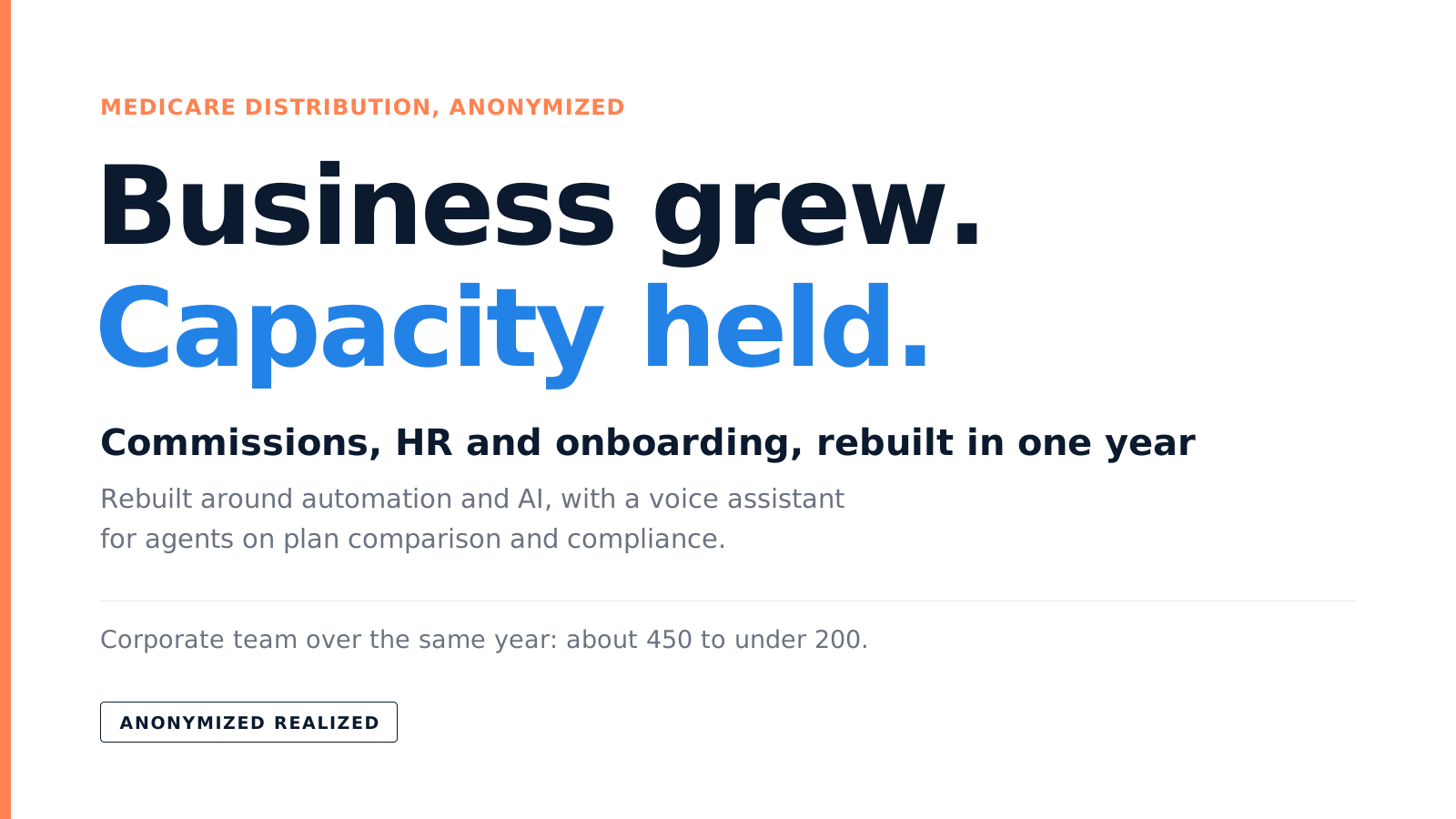
Commissions, HR and onboarding rebuilt while the business grew
A field marketing organization placing Medicare plans for 225,000+ lives through roughly 1,500 agents. Reliable Group rebuilt commissions, HR and onboarding around automation and AI, and gave agents a voice assistant for plan comparison and compliance. Sales capacity held and the business grew through the year, while the corporate team went from about 450 to under 200.
Grew, capacity held
One year: the business grew and sales capacity held. The corporate team went from about 450 to under 200.
This case is from Medicare distribution. We have not published a TPA engagement yet.
- Growth and sales capacityanonymized realized
What transfers: Per-account rules, reconciliation and onboarding rebuilt with automation first and people on exceptions, the same pattern as group loads and pend reasons.
Questions TPAs ask
That is the reason for it. Most differences are 834 layout, census columns and benefit build, which are rules we configure group by group. Carve-outs, custom accumulators and anything the plan document leaves open are listed by group, and an examiner keeps them.
No. We build around it, on its files, exports and interfaces rather than screen-clicking bots that break on upgrades. The work we remove sits between that system and group files, repricing returns, carrier EOBs, stop-loss portals and the mailroom. We run what we build.
We sign a subcontractor business associate agreement before any data is touched. PHI stays inside your systems, accessed by named people under your group separation controls. Groups whose contracts bar access from outside the US stay with your US staff; we confirm each in discovery.
With the administrative part: tracking claimants against the specific deductible, drafting the threshold and trigger diagnosis notices the contract requires, and assembling claim detail for reimbursement requests. Your team approves and sends each. Contract basis, lasers and the carrier relationship stay with you.
We date-stamp ERISA plan claims and appeals, flag any near a limit and route appeals to the named fiduciary. Group health plan gag clause attestations are due to CMS by December 31 each year; we prepare each for your sign-off. The plan keeps the obligation.
A fixed fee for one department, usually claims or eligibility, over six to eight weeks. You get a workflow map and a fixed-price proposal for the first build, valued in examiner hours. Then build it yourself, have us build and run it, or stop.
Sources for the rules and deadlines on this pagechecked November 1, 2026
- No Surprises Act open negotiation notices start the federal dispute clock, as of 2026. CMS, payment disputes between providers and health plans, checked November 1, 2026
- QPA, the qualifying payment amount under the No Surprises Act. 45 CFR 149.140, checked November 1, 2026
- ERISA plan claim and appeal limits, with appeals decided by a named fiduciary of the plan. DOL claims procedure, 29 CFR 2560.503-1, checked November 1, 2026
- Gag clause compliance attestations are due to CMS by December 31 each year. CMS, Gag Clause Prohibition Compliance Attestation, checked November 1, 2026
- A self-funded plan keeps the attestation obligation when a service provider files for it. DOL EBSA, ACA FAQs Part 57, checked November 1, 2026
- A vendor handling PHI for a TPA signs a subcontractor business associate agreement. HHS Privacy Rule, 45 CFR 164.502(e)(1)(ii), checked November 1, 2026
Rules change and vary by program, state and contract. Your compliance team confirms what applies to you.
- BAA
- HIPAA
- Posture
- Notice
- BAA
- Where a department handles protected health information, we execute a business associate agreement before Trace is installed or any data is accessed.
- HIPAA
- We execute a Business Associate Agreement before any engagement that touches PHI, and PHI is accessed only inside client-controlled systems by named individuals. Our first healthcare engagement under BAA is in progress.
- Posture
- Ready and aligned describe design posture, not certification. Reliable Group does not currently hold SOC 2 or ISO 27001 certification; our teams operate inside client-certified environments under client controls.
- Notice
- We deploy Trace only after your organization has given team members the written notice required in your state; we provide the notice template.
Your client-specific workflows, data and documentation are yours. Trace is Reliable Group software, licensed under the engagement; third-party tools keep their own license terms.
Last reviewed October 2026
Next step
Stop guessing how your operation works.
Tell us which department eats the most hours. We will say candidly whether measuring it is worth it.