

Specialty healthcare services: care management, pharmacy, lab and health IT
Your margin is made or lost in the queues.
An AI operating partner that measures your intake, billing and support queues, rebuilds the repeatable work and runs it in your systems.

Who we mean
- Care management vendors working plan eligibility files and outreach lists
- Specialty and mail-order pharmacies running benefits investigation and prior auth
- Clinical and reference labs taking paper, portal and EHR-interfaced orders
- Clearinghouses and health IT vendors onboarding providers onto EDI
- Credentialing, utilization review and other vendors paid per transaction under client SLAs
Where the hours and the cash go
Care management: missed guarantees put renewals at risk.
Screening windows close on bad contact data and hand-logged attempts. Automation researches contacts, logs attempts and shows guarantee status before quarter close.
Pharmacy and lab: referrals and specimens wait on paperwork.
Requisitions held for missing diagnosis or insurance, benefits investigations chased before first fill. AI flags gaps at intake; automation runs test claims.
Health IT: late go-lives push revenue out, rejects miss SLAs.
ERA and EFT enrollments chased per payer, 999 and 277CA rejects worked by hand. Automation tracks enrollments; AI groups rejects by cause.

What we do, and what we leave alone
Hand work sets cost to serve. Licensed decisions stay yours.
You are paid per member, script, test or claim, under client SLAs and performance guarantees. Hand work sets your cost to serve, and every miss reaches the client. We take the repeatable intake, status and billing work. Care plans, pharmacist checks, result release and medical necessity stay with licensed staff.
- One queue first: intake, holds, rejects
- Care plans stay with care managers
- Pharmacist verification stays with pharmacists
- Your laboratory director owns result release
How we come in
Step 1: Measure.
After your security review and client contract check, Trace, our measurement software, records task time in one outreach, intake, client services or EDI support team.
Step 2: Map.
Six to eight weeks later: hours by workflow and by client account, what to rebuild first, its measured value, and the architecture.
Step 3: Decide.
Fixed fee, no obligation to continue. You leave with a workflow map and a fixed-price proposal for the first build.
Step 4: Build, run, manage.
Rules and interfaces first, AI for faxes and free text, people for exceptions. Run by us where client contracts allow; the workflows stay yours.

The rebuild
Built so the team grows slower than the client list.
Referrals, requisitions and onboarding packets become structured records. Specialty scripts get the test claim before intake calls. Rejects route to the submitter with the fix; enrollments are tracked to approval. Contact data is researched before each attempt. Payer and plan rules live in systems you own, not with tenured staff.
- Rules and interfaces first
- AI for faxes and free text
- People for exceptions
- Contact data researched before attempts
Medical-supply distribution
Healthcare services
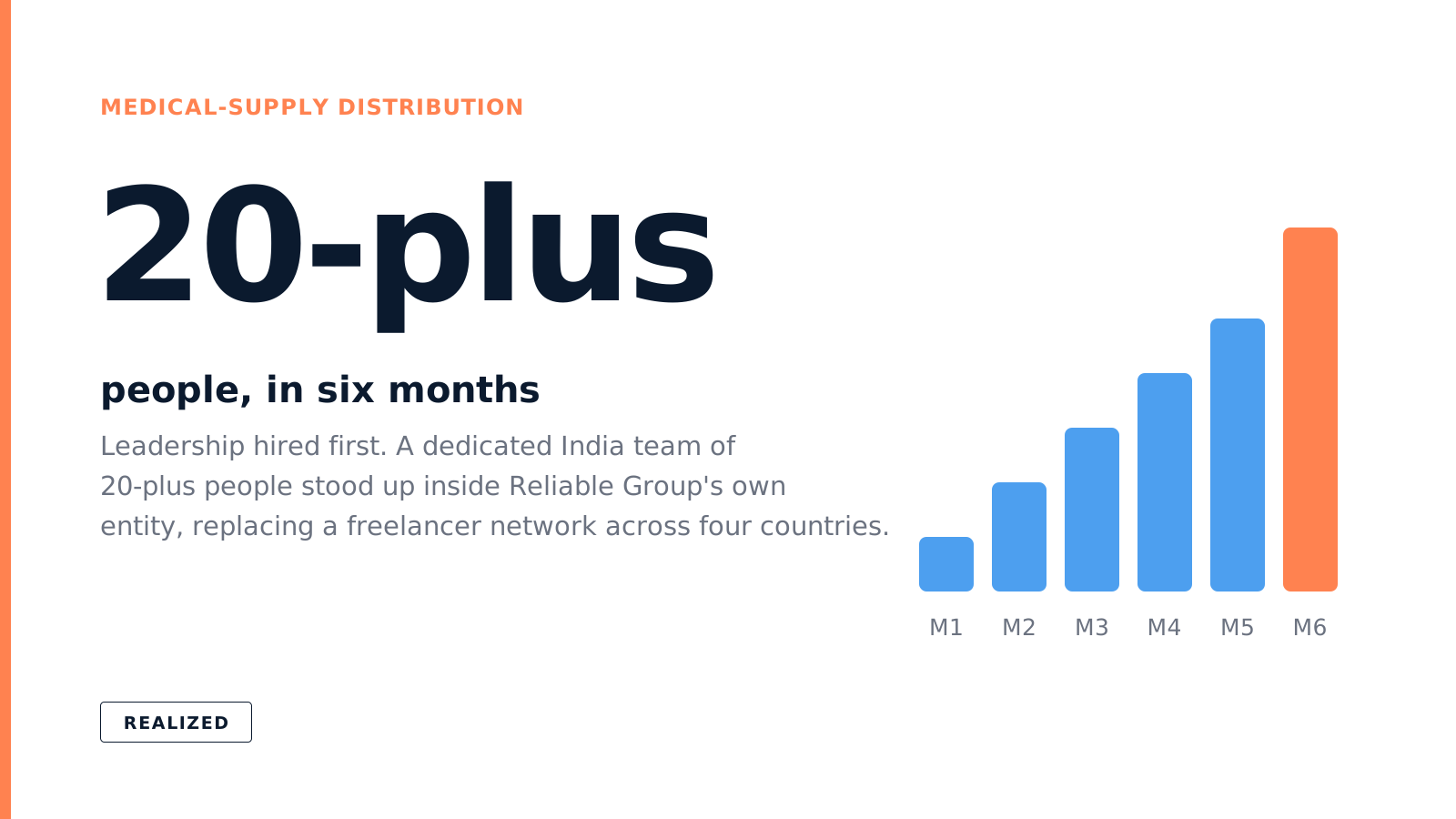
ProKure Digital: a 20-plus person India team in six months
A PE-backed medical-supply procurement and distribution company serving hospitals, FQHCs and clinics on federal program pricing, growing fast. Reliable Group hired the leadership layer first, stood up a dedicated team of 20-plus people in India inside Reliable Group's own entity, and consolidated a freelancer network across four countries into one governed organization, in six months.
20-plus people in six months
A dedicated India team of 20-plus people, leadership hired first, stood up in six months.
No engagement in these segments is published yet. This case shows the method in another back office, not a result in care management, pharmacy, lab or EDI work.
- Team and timelinerealized
What transfers: Only the team setup transfers: leaders hired first and a governed team stood up in six months; it is not evidence of automated outreach, pharmacy, lab or EDI work.
Questions from services leaders
As cost to serve per member, script, test or claim, measured first in hours by queue and by client account. Discovery ranks each repeatable workflow by cost and value. Hours count only when a seat is not backfilled or a hire not made.
A fixed fee for a six to eight week discovery of one department, agreed before we start. The number is in the proposal, not on the website. You keep a workflow map and a fixed-price proposal for the first build, with no obligation to continue.
Yes. If you sell administrative work to payers or providers and it runs through intake, enrollment, eligibility, order, support or billing queues, the model applies. The way in is a discovery of one department, with a report you keep either way.
Yes. We rebuild the administrative layer: eligibility match exceptions, attempts logged against the plan's screening or SNP HRA window, contact data research, unable-to-reach letters, TCPA consent for texts and dialer calls, and plan reporting. Screenings, care plans and clinical conversations stay with your care managers.
The administrative side, where referrals stall before the first fill: the test claim, benefits checks for medical benefit drugs, ePA submission, status tracking and copay assistance enrollment. Pharmacist verification and counseling stay with your pharmacists.
Where the cause is administrative, yes. A build reads each requisition at accessioning, flags a missing diagnosis, insurance or ABN, checks the code against the LCD and drafts the request to the ordering office. The diagnosis still comes from the ordering provider.
The product is software; the margin is operations. Provider onboarding, ERA and EFT enrollment, payer ID upkeep, reject support and ticket triage grow with every account. We measure one queue and rebuild the repeatable part so the team grows slower than the client list.
No. Your team moves between plan portals, Jiva or TruCare, a dialer, an LIS and XIFIN, Salesforce or Jira. Discovery records the work per account and system, so the map shows which variations a build absorbs and which stay with your team.
Not on its own. Before discovery we review the subcontracting, work location and data location terms in your client contracts with you. Work a client will not let us touch stays with your team, and the map shows which work that is.
We execute a BAA, or a subcontractor BAA when you are your clients' business associate, before Trace is installed or any data is accessed, after checking plan and state limits on PHI access. Where Trace is not permitted, we measure from system data, same fee.
- BAA
- HIPAA
- Posture
- Notice
- BAA
- Where a department handles protected health information, we execute a business associate agreement before Trace is installed or any data is accessed.
- HIPAA
- We execute a Business Associate Agreement before any engagement that touches PHI, and PHI is accessed only inside client-controlled systems by named individuals. Our first healthcare engagement under BAA is in progress.
- Posture
- Ready and aligned describe design posture, not certification. Reliable Group does not currently hold SOC 2 or ISO 27001 certification; our teams operate inside client-certified environments under client controls.
- Notice
- We deploy Trace only after your organization has given team members the written notice required in your state; we provide the notice template.
Your client-specific workflows, data and documentation are yours. Trace is Reliable Group software, licensed under the engagement; third-party tools keep their own license terms.
Last reviewed October 2026
Part of our healthcare services practice.
AI operating partner for healthcare services companiesNext step
Stop guessing how your operation works.
Tell us which department eats the most hours. We will say candidly whether measuring it is worth it.