

For dual-eligible special needs plans
When dual status drifts, revenue and members drift too.
A fixed-fee discovery measures one eligibility, encounter or appeals queue; then we rebuild and run it as your AI operating partner.

Where money and members slip
Revenue resting on a dual status nobody reconciled.
The MMR, CMS's monthly membership report, drifts from the state file, and dual status sets the risk score segment.
Encounters rejected by two sets of edits.
Rejected encounters mean diagnoses CMS does not see and state data failing review. Automation pre-checks both edit sets; people fix the rest.
Members lost at renewal.
Deeming tracked from the Medicaid loss, required notices sent and renewal outreach logged, so your team works the reinstatements.
Coordinators chasing HRAs, not members.
HRA outreach, ICT scheduling, care plan mailings and, for coordination-only plans, state admission notices done by hand. Automation takes them; coordinators keep clinical work.

What we do, and what we leave alone
Payment and cost share ride on two files that disagree
When CMS dual status drifts from the state file, payment and cost share land on the wrong payer or the member. Automation flags each mismatch; authorized staff approve the fix.
- We take: status mismatches, encounter rejects, deeming and appeal clocks
- We leave: model of care, coverage and appeal decisions

What we build and run
Rules first, your team on judgment
Deeming clocks, encounter pre-checks and appeal deadlines go to automation first, each step dated for a CMS audit universe. AI reads mail and faxes. People we manage work exceptions.
Medicare distribution, anonymized
Healthcare services
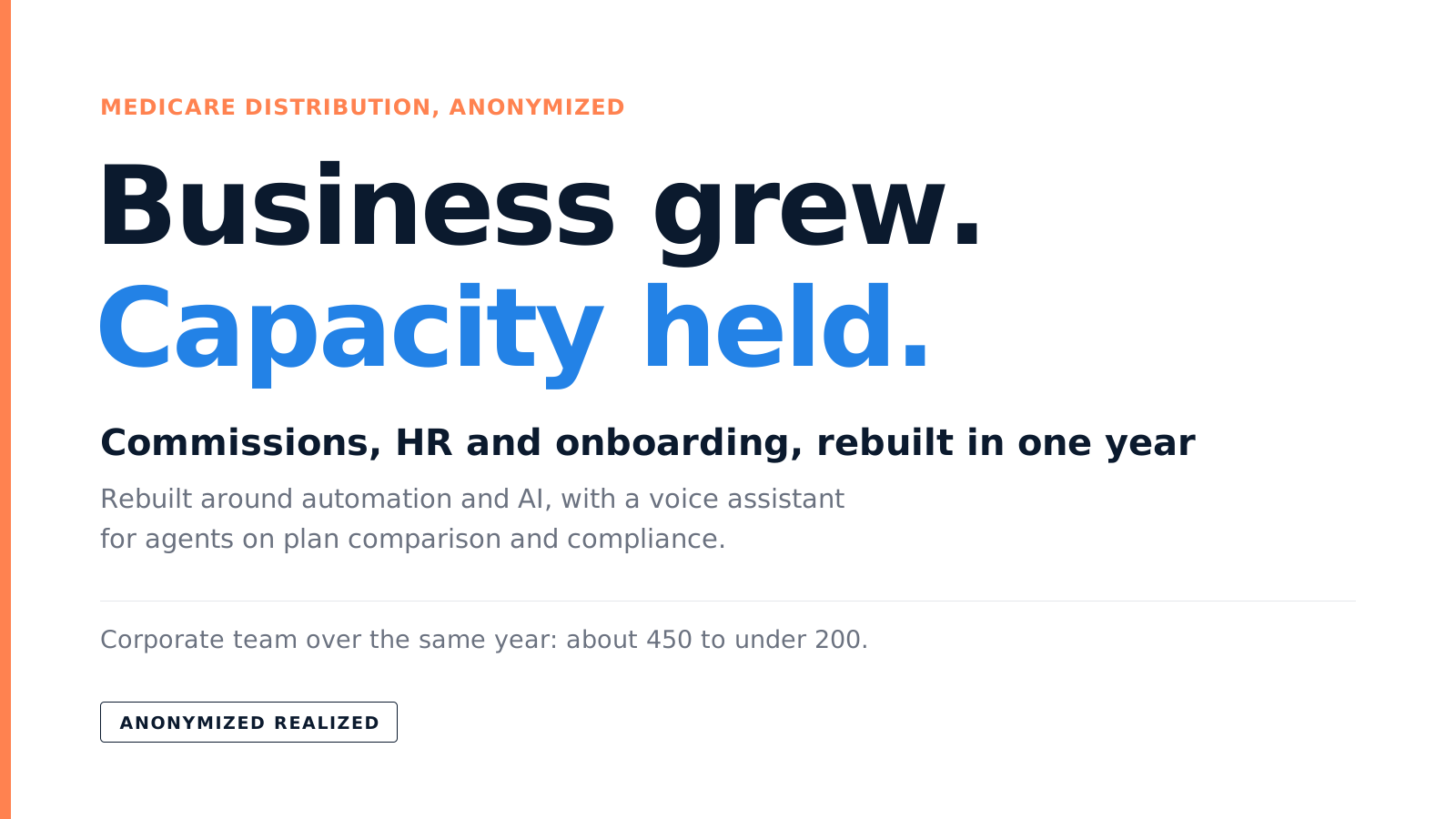
Commissions, HR and onboarding rebuilt while the business grew
A field marketing organization placing Medicare plans for 225,000+ lives through roughly 1,500 agents. Reliable Group rebuilt commissions, HR and onboarding around automation and AI, and gave agents a voice assistant for plan comparison and compliance. Sales capacity held and the business grew through the year, while the corporate team went from about 450 to under 200.
Grew, capacity held
One year: the business grew and sales capacity held. The corporate team went from about 450 to under 200.
No D-SNP case is published yet; this one shows the operating model only.
- Growth and sales capacityanonymized realized
What transfers: Dated, rules-driven enrollment steps run automation first, people on disputes: the pattern behind deeming work.
Questions D-SNPs ask
Automation compares the MMR to the state file. We research each mismatch in the state system and MARx, including changes not yet sent to CMS in the MMA file. Your authorized enrollment staff approve each correction, and the Part D LIS level follows it.
A fixed fee, agreed first, for a six to eight week discovery of one department. We suggest enrollment, where the MMR and state file meet. No savings figure before measuring. You leave with a workflow map and a fixed-price proposal for the first build.
From 2027, certain D-SNPs limit enrollment to members of their affiliated Medicaid plan, and more materials and appeals become integrated. So Medicare and Medicaid records have to match. We take the reconciliation and clock tracking; plan design and state contracting stay with you.
The tracking, yes: flagging Medicaid loss, starting the deeming period your plan elected, sending required notices and logging renewal outreach. Your enrollment staff decide reinstatement or disenrollment. For SNPs, federal rules allow 30 days to six months; some states set longer minimums.
Yes, as administrative work: pre-checking 837-I and 837-P files against CMS and state edits, working 999, 277CA, MAO-002 and state rejects, sending replacements and voids, and reconciling MAO-004 risk adjustment status. Diagnosis coding stays with your coders.
We track integrated reconsideration clocks, continuation of benefits requests, IRE forwarding of adverse Medicare decisions and the state fair hearing window, and assemble case files and acknowledgment letters. Coverage decisions stay with your reviewers. Stricter state contract timeframes govern where they apply.
Sources for the rules and deadlines on this pagechecked November 1, 2026
- The MMR comes from MARx and is used to reconcile plan membership. CMS, MARx software release announcement, April 10, 2026, checked November 1, 2026
- States report dual status to CMS in the MMA file, which CMS uses for Part D LIS and MA payment. CMS, State MMA File of Dual Eligible Beneficiaries, checked November 1, 2026
- Full and partial benefit duals score in separate risk adjustment segments. CMS Medicare-Medicaid Coordination Office, dual eligible definitions and MMA codes, checked November 1, 2026
- Providers may not bill QMBs for Medicare cost sharing; the state or the D-SNP pays, by state and plan design. Integrated Care Resource Center, preventing improper billing, checked November 1, 2026
- Part D sponsors update LIS status on best available evidence and process retro cost share refunds and recoveries. 42 CFR 423.800, checked November 1, 2026
- From 2027, certain D-SNPs limit enrollment to members of their affiliated Medicaid plan, expanding integrated materials and unified appeals. CMS, CY2025 Medicare Advantage and Part D final rule fact sheet (CMS-4205-F), checked November 1, 2026
- SNPs may deem a member continuing eligible for 30 days to six months. 42 CFR 422.52(d), checked November 1, 2026
- Some states set longer D-SNP deeming minimums. California DHCS, D-SNP Medicare deeming, checked November 1, 2026
- Disenrollment for loss of special needs status, with advance and final notices. 42 CFR 422.74(d)(8), checked November 1, 2026
- Encounters go to CMS as 837 institutional and professional files; EDFES returns 999 and 277CA acknowledgments and EDPS returns MAO-002 status reports. CSSC Operations, Encounter Data 101, August 2014, checked November 1, 2026
- The MAO-004 report lists encounter diagnoses eligible for risk adjustment. CSSC Operations, EDS and RAPS reports webinar, February 2015, checked November 1, 2026
- Applicable integrated plans acknowledge integrated grievances and reconsiderations in writing; states may set more protective timeframes. 42 CFR 422.629, checked November 1, 2026
- Continuation of benefits pending an integrated reconsideration. 42 CFR 422.632, checked November 1, 2026
- Adverse integrated reconsiderations go to the IRE for Medicare benefits and to a state fair hearing for Medicaid. 42 CFR 422.634, checked November 1, 2026
- Coordination-only D-SNPs notify the state of hospital and SNF admissions for a state-defined group. 42 CFR 422.107(d), checked November 1, 2026
- SNPs run a model of care with HRAs, an interdisciplinary care team and individualized care plans. 42 CFR 422.101(f), checked November 1, 2026
- Required D-SNP denial notices use CMS forms. CMS, Integrated Denial Notice form instructions (CMS-10003), checked November 1, 2026
- CMS program audits, including the SNP model of care area, request data universes. CMS, 2021 program audit process overview, checked November 1, 2026
Rules change and vary by program, state and contract. Your compliance team confirms what applies to you.
Sources for the rules and deadlines on this pagechecked November 1, 2026
- The MMR comes from MARx and is used to reconcile plan membership. CMS, MARx software release announcement, April 10, 2026, checked November 1, 2026
- States report dual status to CMS in the MMA file, which CMS uses for Part D LIS and MA payment. CMS, State MMA File of Dual Eligible Beneficiaries, checked November 1, 2026
- Full and partial benefit duals score in separate risk adjustment segments. CMS Medicare-Medicaid Coordination Office, dual eligible definitions and MMA codes, checked November 1, 2026
- Providers may not bill QMBs for Medicare cost sharing; the state or the D-SNP pays, by state and plan design. Integrated Care Resource Center, preventing improper billing, checked November 1, 2026
- Part D sponsors update LIS status on best available evidence and process retro cost share refunds and recoveries. 42 CFR 423.800, checked November 1, 2026
- From 2027, certain D-SNPs limit enrollment to members of their affiliated Medicaid plan, expanding integrated materials and unified appeals. CMS, CY2025 Medicare Advantage and Part D final rule fact sheet (CMS-4205-F), checked November 1, 2026
- SNPs may deem a member continuing eligible for 30 days to six months. 42 CFR 422.52(d), checked November 1, 2026
- Some states set longer D-SNP deeming minimums. California DHCS, D-SNP Medicare deeming, checked November 1, 2026
- Disenrollment for loss of special needs status, with advance and final notices. 42 CFR 422.74(d)(8), checked November 1, 2026
- Encounters go to CMS as 837 institutional and professional files; EDFES returns 999 and 277CA acknowledgments and EDPS returns MAO-002 status reports. CSSC Operations, Encounter Data 101, August 2014, checked November 1, 2026
- The MAO-004 report lists encounter diagnoses eligible for risk adjustment. CSSC Operations, EDS and RAPS reports webinar, February 2015, checked November 1, 2026
- Applicable integrated plans acknowledge integrated grievances and reconsiderations in writing; states may set more protective timeframes. 42 CFR 422.629, checked November 1, 2026
- Continuation of benefits pending an integrated reconsideration. 42 CFR 422.632, checked November 1, 2026
- Adverse integrated reconsiderations go to the IRE for Medicare benefits and to a state fair hearing for Medicaid. 42 CFR 422.634, checked November 1, 2026
- Coordination-only D-SNPs notify the state of hospital and SNF admissions for a state-defined group. 42 CFR 422.107(d), checked November 1, 2026
- SNPs run a model of care with HRAs, an interdisciplinary care team and individualized care plans. 42 CFR 422.101(f), checked November 1, 2026
- Required D-SNP denial notices use CMS forms. CMS, Integrated Denial Notice form instructions (CMS-10003), checked November 1, 2026
- CMS program audits, including the SNP model of care area, request data universes. CMS, 2021 program audit process overview, checked November 1, 2026
Rules change and vary by program, state and contract. Your compliance team confirms what applies to you.
- BAA
- HIPAA
- Posture
- Notice
- BAA
- Where a department handles protected health information, we execute a business associate agreement before Trace is installed or any data is accessed.
- HIPAA
- We execute a Business Associate Agreement before any engagement that touches PHI, and PHI is accessed only inside client-controlled systems by named individuals. Our first healthcare engagement under BAA is in progress.
- Posture
- Ready and aligned describe design posture, not certification. Reliable Group does not currently hold SOC 2 or ISO 27001 certification; our teams operate inside client-certified environments under client controls.
- Notice
- We deploy Trace only after your organization has given team members the written notice required in your state; we provide the notice template.
Your client-specific workflows, data and documentation are yours. Trace is Reliable Group software, licensed under the engagement; third-party tools keep their own license terms.
Last reviewed October 2026
Next step
Stop guessing how your operation works.
Tell us which department eats the most hours. We will say candidly whether measuring it is worth it.